
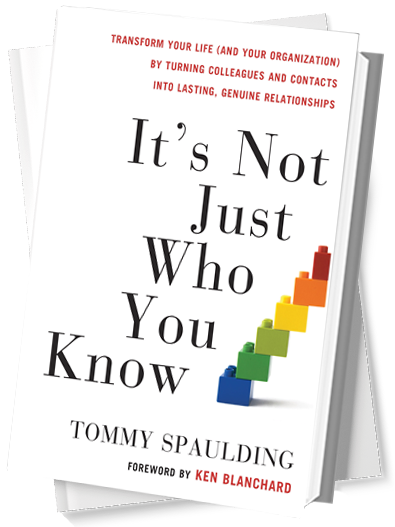
Building relational capital is how Tommy Spaulding explains creating relational equity in his book entitled It’s Not Just Who You Know. With a wealth of information that I am sure to reference repeatedly in my own research, Spaulding exposes the reader to “relationship economics…how to define relationships that matter, how we can create relationships that matter and how we can grow relationships that matter.” Once again, I discover familiar vocabulary emerging when discussing relationships such as cultivate, grow, and flourish. Where my mentoring model uses bubbles to describe the overlapping nature of relationships in our lives, Spaulding uses an elevator stating that “relationships are too dynamic to fit into a box (or building), some overlap on different floors, some move up and down like an elevator.”

Expanding on the elevator concept, Spaulding offers what he calls “Five Floors of Relationships” with a progression from the first floor to the penthouse to help readers visualize the various relationships in our lives and how our “closest, deepest relationships are Fifth Floor, or Penthouse relationships.” Having earlier addressed the contrast between weak ties in “The Strength of Weak Ties” and strong ties in “Who’s in Your Posse?” along with the difference between transactional and transformational experiences, I will now introduce another variation to these same themes:
First Floor Relationships – those with whom we share surface level facts about ourselves and follow the rules of social niceties; trade business cards, share lunch, these are typically transactions
Second Floor Relationships – those with whom we begin to share more personal information but are still fairly basic; social obligations, job requirements, polite conversations about NSW (news, weather, sports), still mostly transactional because there are no emotional risks
Third Floor Relationships – those with whom we develop an emotional comfort level to move beyond facts and information; we begin to share opinions and feelings even if from competing viewpoints; we learn more about others and understand more about the person God created them to be, we move more to the transformational side but still may hit the “Wall of Conflict where relationships stall because conflict can act as a locked door to something deeper”
Fourth Floor Relationships – those with whom we have common interests, there is increased respect and trust, share more private details of our lives and feel supported without judgment; the relationships on this floor are more transformational in we value the relationship for its own sake
Fifth Floor Relationships – those with whom we are willing to be vulnerable; these transformational relationships are built on authenticity and loyalty; time and energy are invested here and often these relationships are more about giving than getting
One cannot overlook the simple fact that most relationships will begin on the first floor and progress towards a floor above; however, some may never move beyond the first floor, but are we seeking God’s wisdom and discernment for where the elevator stops? Spaulding shares, “All relationships require hard work, patience, understanding, and yes, tactics and strategies designed to make them blossom [flourish]…The key to creating a rich network of relationships; however, is understanding this deep and basic truth: motives matter. If all we care about is using others to advance our career and our net worth, our relationship will have no lasting value. It may work for a time, or in a few specific situations, but the foundation on which you build your relationships will be unstable, and the relationship ultimately will collapse.”
Challenged by the writings of many authors including Jay and Spaulding, I now must navigate how to encourage emerging adults to consider these weighty issues, possibly before they are ready to hear it. How can we as advisers, educators, coaches, and influencers encourage the importance of being intentional about the relationships they form from those weak ties that might offer assistance professionally to those in their posse who they will depend on for moral and spiritual support? An even greater obstacle for Gen Z is how to identify real relationships in a socially connected world when appearances can be deceiving, and an on-screen image is inconsistent with a person’s real image.
If you are yet unconvinced of the need for emerging adults (Gen Z) to have trustworthy, Godly mentors in their lives, please return for future postings as we will examine the statistics from research about this generation’s lack of connection to the church, the instability of this season of life, and the role us “seasoned” Christians should feel compelled to fulfill.
Are there other models you have discovered which describe the various relationships which exist in our lives? Which ones resonated most with you and why? Please share in the comments below.
 Flourishing @ Life
Pingback: Think Crockpot Not Microwave – Flourishing @ Life
Pingback: Give Me a Minute – Flourishing @ Life
Pingback: Are You a Good Neighbor? – Flourishing @ Life
Pingback: Essential Nutrients of Relational Equity – Flourishing @ Life
Pingback: I Sliced Instead of Peeled – Flourishing @ Life
Pingback: Courageous Conversations – Flourishing @ Life
Pingback: Leaders Who Flourish – Flourishing @ Life
Pingback: Armor Off – Flourishing @ Life
Pingback: The Three, the Twelve, the Others – Flourishing @ Life
Pingback: Friendship Conversations – Flourishing @ Life
Pingback: Tuesday People – Flourishing @ Life