
If I asked you to be completely honest with yourself at this exact moment, are you reading this post with all of your attention or is your mind still sorting through the email subject lines from a few minutes ago? Focusing in today’s world of constant distractions is a difficult task, and a common result of switching between tasks is what Sophie Leroy identifies as attention residue. Cal Newport shares Leroy’s concept in Deep Work: Rules for Focused Success in a Distracted World where it is explained that “when you switch from Task A to another Task B, your attention doesn’t immediately follow-a residue of your attention remains stuck thinking about the original task.” Newport and other researchers in neuroscience explain the myth of multitasking, proving that although we may think we can focus on several tasks at once, that focus is in reality divided.
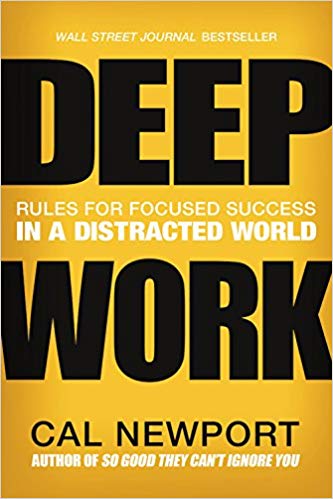
Confronting readers to consider the comparison between what he categorizes as shallow work and deep work, Newport challenges that in order “to produce at your peak level, you need to work for extended periods with full concentration on a single task free from distraction” which is paradox to most educational and organizational environments. So, if one desires to flourish in their personal or professional life, it appears critical to understand both types of work and how to navigate the delicate balance between the two.
Defining shallow work as “noncognitively demanding, logistical-style tasks, often performed while distracted,” and deep work as “professional activities performed in a state of distraction-free concentration that push your cognitive capabilities to their limit,” Newport emphasizes that in our current culture of knowledge workers, “deep work is becoming a key currency.” If emerging adults desire to flourish in this economy, then cultivating the skill of deep work will be necessary. Newport explains that in this new economy, “three groups will have a particular advantage: those who can work well and creatively with intelligent machines, those who are the best at what they do, and those with access to capital.”
So, as I ponder the importance of deep work for my own career and tussle with course content for college students, how should deep work be cultivated? As Gabby Morocco described in her post You Can Do Hard Things, faculty and students are called to “join the group of those who can work well” and that “you hone your ability to master hard things.” For Gen Z this means learning rapidly changing technologies, not just the consumer products like social media and smartphones, but technology that drives the workplace, and because this technology consistently changes, the “mastering of hard things never ends: You must be able to do it quickly, again and again.” Even in the world of collegiate athletics, statistical and design software changes frequently, therefore, “if you can’t learn, you can’t thrive [flourish].”

If being able to master hard things requires deep work, how do we shake off the attention residue and acquire the necessary skills to produce? Newport shares that people master hard skills through deliberate practice and deliberate practice cannot exist alongside distraction. Whether examining a professional athlete or a master craftsman, we have witnessed the vitality of putting aside distractions and focusing intently on the goal to be accomplished, often only succeeding after floundering a bit and dedicating many hours to learning these hard things.
If you are a college student or a current professional, Newport offers suggestions for disciplining your life to maximize the deep work and reduce the time spent on shallow work. In addition to understanding these concepts from a vocational standpoint, we can also be challenged to consider the investment of our time and resources as either deep or shallow. If my desire is to mentor another individual, should I not invest my time in the deep work of creating relational equity rather than in the shallow work of discussing news, weather, and sports?
Attempting to avoid attention residue is hard work! Learning how to intentionally organize your life to increase the productivity of deep work is a monumental task and the reason why many will never reach this state of flourishing. Newport offers that by “ruthlessly reducing the shallow while preserving the deep, this strategy frees up our time without diminishing the amount of new value we generate.” In future posts, I may explore more in depth the strategies shared in Deep Work, but for now, I will ask you to offer suggestions for how you are currently eliminating distractions and focusing on the deep work God has called you to do.
 Flourishing @ Life
This article was intriguing for me to read. It is especially relatable since we are college students trying to maintain a delicate balance. In the article shallow work and deep work are defined. Shallow work is defined as tasks that we perform while distracted, while deep work is defined as tasks that are performed without distraction and test our cognitive abilities. This distinction is extremely important because I always find myself treating tasks that should be deep work as shallow work. Like the article said, deep work takes hard work. Eliminating distractions is key. I think simple things like putting away our electronic devices or studying in a quiet place by ourselves can be helpful. I’ve found that thirty minutes of hard work without my cell phone to distract me is more meaningful than two hours of work with it. I think another way to maximize our work time is to take frequent breaks. No one can perform deep and meaningful work without a break. These breaks should be short but enough time to replenish our thought processes and be ready to dive back in.
LikeLike
Reading this blog provided a moment of self-reflection for me. The concepts mentioned regarding shallow work and deep work were intriguing. I feel that I operate in “shallow work- mode” because of my ADHD diagnosis. Moments of deep work are very difficult due to my hearing every small sound amplified (pencil taps, coughs, and keyboard tapping, for example). The smallest movement of classmates or teachers can break my focus. I’ve even been distracted by the smallest insect that my eyes somehow find crawling on the floor beside me! I feel that I constantly have “attention residue”. Also, the anxiety from having to complete a test in a certain amount of time affects my performance. The things that have helped me cope up to this point are trying to get enough sleep, trying to stay organized, scheduling set study times, and taking my prescription medication consistently. Private testing and having extended time for test-taking have definitely eased my test anxiety. Hopefully, striving for more “deep work” moments with the help of the above strategies will improve my college success despite my ADHD diagnosis .
LikeLike
Pingback: The Habit of Deep Work – Flourishing @ Life
Pingback: Continuous Partial Attention – Flourishing @ Life