
It’s the middle of March in 2020 as I compose this blog post and our society is currently in a state of panic over the threat of the spread of the coronavirus. With sporting events and church services being cancelled and colleges transitioning to online instruction, the world seems slightly unsettled at the moment. Not one to panic over situations outside of my control, I must admit that the actions being taken at this time do seem a bit surreal and more common to a movie plot than real life; however, I refuse to panic. Prudent choices will be made with regards to travel plans at the end of the month, and I am honoring the social distancing practices that are being asked of me. But for someone who believes in a God who is omnipotent, omnipresent, and omniscient, my worries need to continue no further than what I can control because my hope is in Him and not in this world.
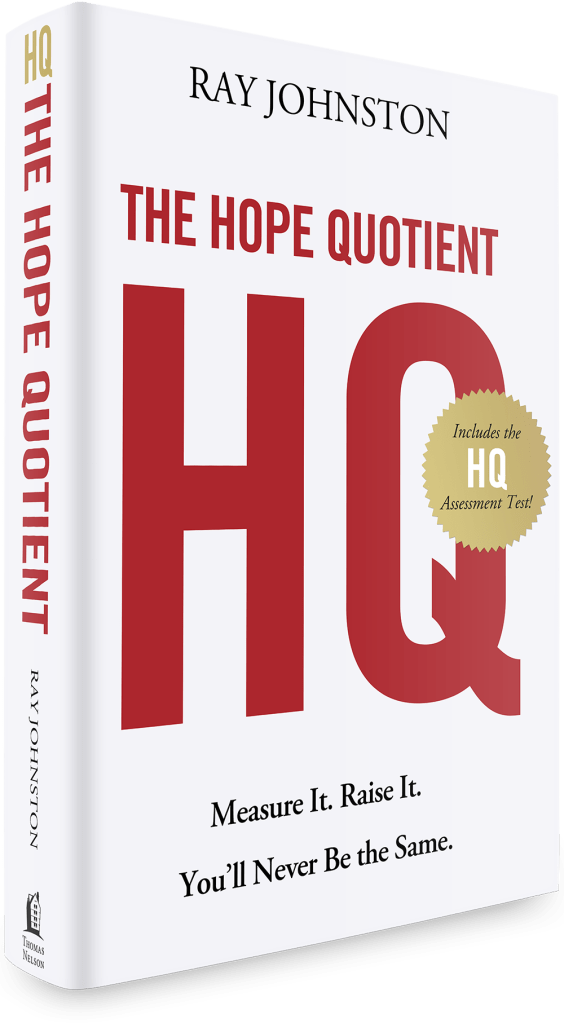
Finishing Ray Johnston’s book entitled The Hope Quotient this week, it seems fitting to share some of his insights here in this blog as we enter a season of the unknown. To come across this work in the journey to identifying characteristics of a flourishing life at this specific time seems providential. Many people might be familiar with the terms IQ (intelligence quotient) and EQ (emotional intelligence quotient) as these concepts have been studied over the last few years, specifically their relationship to success in life and relationships; however, Johnston offers a third type of quotient, HQ. “Let me give you the whole book in one sentence: thriving [flourishing] people thrive [flourish] for one reason—they commit to things that produce inner strength and hope. And here’s the good news. Unlike IQ and EQ, which are largely inherited, your degree of hope, your ‘Hope Quotient’ or HQ, can be developed to any level.”
In The Hope Quotient, readers are offered seven factors that “support, sustain, and strengthen hope,” and when “a struggling individual gets just a 10 percent boost in hope, almost anything becomes possible.” So, let’s delve into the seven factors outlined by Johnston and then consider how they apply to the current COVID-19 crisis: (1) recharge your batteries; (2) raise your expectations; (3) refocus on the future; (4) play to your strengths; (5) refuse to go it alone; (6) replace burnout with balance; and (7) play great defense. One of the aspects that resonates with me about HQ is that it is “a forward-facing confidence. Maybe you’ve been in some places or gone through some years where the best view is in the rearview mirror. But hope has no hindsight. We never hope backward. We always hope forward. Hope connects us to our future and determines that future.” These concepts are especially vital as we guide an anxious Gen Z through a turbulent issue.
If we just examine the first two factors and apply them to the COVID-19 crisis, I see opportunities for strengthening our HQ. What recharges your batteries? For each of us this examination will look differently, but this time of social distancing might be the perfect opportunity to invest time in activities which re-charge us that often are pushed aside due to conflicting schedules. Many of us are now experiencing some flexibility in our days, how will you use this opportunity to recharge? As Christ followers, we are encouraged to consider times of Sabbath, might this break from the usual hustle and bustle be used as a time of rest and recharging?
The second factor Johnston shares with us is to raise your expectations. What an opportunity to offer prayer to an omniscient God who can handle any crisis. What if I were to raise my expectations that God is truly in control? What if I raise my expectations that the leaders making decisions on behalf of organizations all over the country are doing so with the best information available and with the intent of protecting the greater good? After witnessing the outpouring of love for our campus after the tornado in 2008 and the response to the tornado this month in Middle Tennessee, I can raise my expectations that people can respond with love and understanding in a time of crisis. Replace fear with faith.

What is your current HQ? How can you raise the HQ of those within your sphere of influence? Can you become an inspiration like Union student-athlete Kristen Pickens, who is encouraging other athletes? We all have an opportunity at this point in time to raise our own HQ and the hope of those around us. What if we were to spread hope the same way that others have spread panic?
References:
 Flourishing @ Life
In this time of panic, fear, and uncertainty, the world could use an increase in the HQ, hope factor. People on social media are attempt to bring a sense of hope by creating trends on different media platforms. While that’s a great plan for the moment, it is only temporary. The seven factors outlined by Johnston to boost hope are great, practical ways to spread and maintain hope in times of crisis. One of the factors applied to COVID-19 was “recharge your battery”. During this time, most people have a lot of free time which allows us to slow down and really appreciate the people in our lives. Recharging our battery looks different for everyone, but it is essential for restoring hope. The Church’s responsibility in this crisis is to spread the lasting hope and love that we have rooted in Christ.
LikeLike
Pingback: RQ – Flourishing @ Life
Pingback: Emotional Adolescent – Flourishing @ Life
Pingback: Holding Space – Flourishing @ Life