
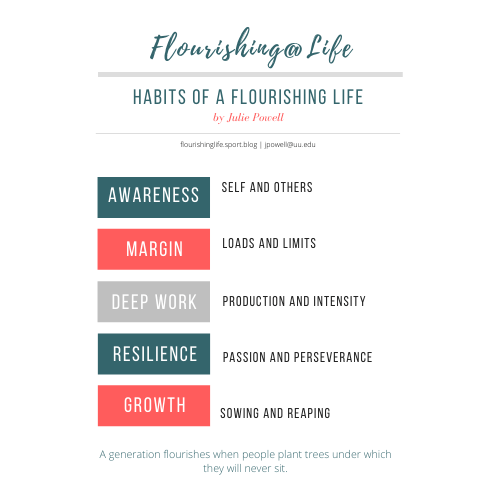
As the pilgrimage continues to uncover the characteristics which could potentially lead a person to flourish either personally or professionally, we’ve identified five habits that become essential nutrients in this quest: awareness, creating margin, deep work, resilience and growth. The challenge now shifts from identification of these habits to the development of the rituals and disciplines one should embrace in becoming the person they aspire to be. In order to reach this potential, a framework of actions, small steps, are necessary as outlined by James Clear in his book entitled Atomic Habits: An Easy and Proven Way to Build Good Habits and Break Bad Ones.
Blending research from Clear, Charles Duhigg’s The Power of Habit and J.W. Earley’s The Common Rule, we will address these author’s applications to the Five Habits of a Flourishing Life. Most of what will be offered here are things you might already know, but “As C.S. Lewis once said, ‘people need to be reminded more often than they need to be instructed.’” And although our approach has been to investigate the topic from a personal perspective, each of these authors emphasize the application to organizations as well. Duhigg offers, “It’s not just individuals who are capable of such shifts. When companies focus on changing habits, whole organizations can transform.” Consider the importance that “each habit means relatively little on its own, but over time, the meals we order, what we say to our kids each night, whether we save or spend, how often we exercise, and the way we organize our thoughts and work routines have enormous impacts on our health, productivity, financial security, and happiness.” These impacts can be both personal, professional, and organizational.
So, now that we have arrived at this destination on the journey, let’s linger a bit and savor the significance of investing time and energy into building good habits into our daily routines. Grateful to the disciplines of neuroscience and psychology, we now understand “why habits emerge, how they change, and the science behind their mechanics. We know how to break them into parts and rebuild them to our specifications,” explains Duhigg. The problem for most of us is that developing a habit is not a simple process, but if we invest the time to build self-awareness of our own tendencies and learn “the structure of the habit loop, it makes them easier to control. Once you break a habit into its components, you can fiddle with the gears.”
Ready to fiddle with the gears? Clear defines a habit as “a routine or behavior that is performed regularly—and, in many cases, automatically” so that our brain saves energy for more important tasks. What Clear shares is “a synthesis of the best ideas smart people figured out a long time ago as well as the most compelling discoveries scientists have made recently.” Building on Duhigg’s “cue, routine, reward” concept, the “backbone of [Atomic Habits] is a four-step model of habits—cue, craving, response, and reward—and the four laws of behavior change that evolve out of these steps.” In a future posting, I will outline Clear’s four-step model and the laws of behavior so that we can apply them to the Five Habits of a Flourishing Life.
But before we journey into applying Clear’s ideas to creating a flourishing life, let’s be clear (no pun intended) on how industries are currently manipulating behavior patterns of their consumers, so we can better understand the impact that habits and routines have on our lives. Deep inside, we know these practices exist, but bringing them into the light creates an enhanced awareness; and for me personally, the more I consider the patterns a marketing company finds useful, the more consideration I should give to the habits and behaviors I instill in my personal and professional identities. So, tune in next time for the next installment in Developing the Five Habits of a Flourishing Life.
 Flourishing @ Life