
How do you know when you’ve made a good choice? What criteria do you use to evaluate a bad choice? How did you choose the brand of toothpaste that squeezed a colored glob of goo on your toothbrush this morning? Assuming that you participated in that daily ritual this morning, the answer you provide may be as simple as, “It was the brand located in the bathroom next to my toothbrush” because maybe you aren’t the household purchaser of personal care items. Pondering a different route in response, you might offer, “After tasting brands A, B, and C, I determined that Brand B created a minty-fresh tingling feeling that I enjoy.” (As an aside, there is a great story about toothpaste in Duhigg’s Power of Habit.)

Many of the decisions we formulate each day, such as the one about toothpaste, do not require intense thought to their long-term consequences. If reports are true that the average American makes over 35,000 decisions each day, it would be time consuming to use a filter for each one (and also explains why I am so exhausted). However, there are some decisions we make that need slightly more attention than our toothpaste brand. And although many of these decision-making opportunities are situational, there are some tools we can add to our toolbox that will equip us to make the best decision possible whether we are addressing a personal or professional issue.
If you wander through my house (or have the ability to wander in my mind without getting lost), you might find notations related to a message from Andy Stanley that I have listened to numerous times. On a white notecard, you will likely see this inquiry written, “What’s the wise thing to do?” Stanley’s challenge continues with a deepening of this question by offering, “In light of your past experiences, your current circumstances, and your future hopes and dreams, what is the wise thing to do?” Wanting to offer listeners with an opportunity to cease making bad decisions, Stanley offers a lens with which to evaluate their choices. In other words, the decisions one makes, can be filtered through these questions.
Mirroring the process Stanley offers, in her book Made to Flourish, Trebesch highlights organizations that thrive by using what she calls The Ecology of Organizations Model which utilizes systems thinking to describe a cause and effect loop. In the business and management world, we have systems thinking; in educational models, we have design thinking; and if we blend ingredients of these two models together, perhaps we create Flourishing Thinking. (If you desire to read more about this process, please click on the above word to follow the link to a previous post).
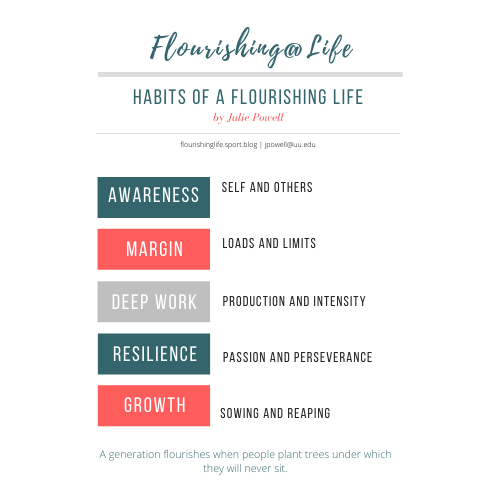
So, if we revisit the opening questions above using a Flourishing Thinking perspective, perhaps we now possess a new tool, which assists in the decision-making process, called a Flourishing Filter. This new filter, which utilizes the Five Habits of Flourishing, guides us through a systematic process in efforts to make the wisest decision possible. Let’s consider this scenario: A young sport professional has been asked to serve as a board member for a reputable organization and she uses the Flourishing Filter to coach herself through this decision (in addition to seeking guidance from reliable mentors). On a notepad, she composes answers to the following questions:
- (1) Will serving on this board create better awareness of myself and others?
- (2) How will serving on this board impact my life in areas where I may need some margin such as with my time?
- (3) Will serving in this position offer me opportunities to engage in deep work that fulfills a greater purpose?
- (4) Will serving in this position create more resilience in my life such as learning to be patient with slow processes often found in organizations?
- (5) Will this position allow me to grow as both a person and a professional?
Lastly, the Flourishing Filter might ask if any of the Habits would be hindered by serving in this position. Just as one might list the pros and cons of an issue, the Flourishing Filter systematically prompts deep questions beyond a simple yes or no. Once the young sport professional uses the filter, the visual I imagine in front of her looks similar to a yes/no flowchart but with greater intentionality to long-term thinking.
Going beyond the all-important toothpaste brand decision making, in what other specific situations could you picture an opportunity to use a Flourishing Filter? Please share your thoughts in the comments below.
 Flourishing @ Life
Pingback: Appreciative Examen – Flourishing @ Life