
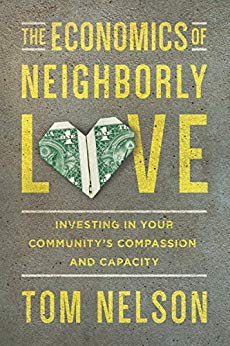
Admittedly, my intrigue radar blipped when as the research for neighborly love and hospitality led me to Tom Nelson’s book entitled The Economics of Neighborly Love: Investing in Your Community’s Compassion and Capacity and his challenge to think about love, investing, and vocation in an entirely new light. As a professor attempting to guide emerging adults to seek a flourishing life, there is a critical need, especially for Gen Z, to connect the vocational side of life to the spiritual. Nelson identifies what he calls the Sunday to Monday Gap when we fail to see our jobs as an extension of our faith and as an outlet to love our neighbors within an economic system. “The gospel compels us to live in such a God-honoring way that we do honest work, make an honest profit, and cultivate economic capacity to serve others and help meet their economic needs. Our diligent work creates economic value, and economic value leads to economic capacity for living generously.”
Surprisingly, most college students, and possibly older adults too, rarely consider the amount of time spent over a lifespan invested in a job. In a Life Calling presentation, I highlight the statistic that a person will spend over 150,000 hours at work, and when students compose their reflections on this presentation, this appears to be a number that shocks them. The desire is that emerging adults will deeply consider their vocation alongside of who God has created them to be. When someone considers His will for our lives and discovers how to connect that will to their vocations across the lifespan, they will ultimately live a flourishing or satisfying life, which has been highlighted as especially significant for Gen Zers.
Because Nelson’s education “failed to connect faith and economics in a meaningful way” early in his life, he has chosen to address the issue that “far too little has been written or taught to the rising generation of leaders about how theology and economics seamlessly intersect.” While Nelson outlines the connection between being made in God’s image and how this plays out through our vocation, he reminds us that “humans are endowed with two essential and unique characteristics in the created order. First, we were designed to experience relational connection with our relational God. Second, we were given the creative capacity to reflect God in all that we are and do.” For most of us, how we serve and how we love others will manifest itself through our identity and profession. While “theologians use words like flourishing and fruitfulness to speak of adding value to the world, economists use words like productivity, opportunity and wealth.”
There are many beautiful lessons that Nelson shares including that “The Great Commandment challenges us to better connect Sunday to Monday, not only by nurturing compassionate hearts but also by growing our economic capacity. And economic capacity does not appear out of thin air. It comes from our faithful vocational stewardship. The financial margin we need for generosity flows from a lifestyle of wise financial investment.” Here, we see a connection between economic capacity and developing a Habit of Margin where when we have taken steps to be good stewards of our financial blessings, we are in a better position to love our neighbors. “Human work is not a solitary enterprise; it is woven into the fabric of human community’s flourishing design. Doing our work well matters to God and to our neighbor. The best workers make for the best neighbors.”

We are encouraged to “engage economic systems with a theological perspective” so that “through the good collaborative work we are called to do every day,” people will “see our work and the kind of workers we are, as well as the ways we add value to others and how we care for the neighborhood,” then “they will get a powerful glimpse of who Jesus is and why he matters so much to our broken world.” As we develop a Habit of Awareness with regards to our work and how it contributes to others, we can economically contribute to the flourishing of others by “taking a holistic approach to loving our neighborhoods as we seek to make a difference wherever God has planted us in our vocational callings.”
Have you witnessed people who were able to love and bless others because they were obedient to their vocational callings, and as a result had the financial means to economically impact those around them by closing the Sunday to Monday Gap? Please feel free to share in the comments section below.
Reference:
Nelson, T. (2017). The economics of neighborly love: Investing in your community’s compassion and capacity. IVP Books.
 Flourishing @ Life