
Without delving into deep research on the topic, most sources I found seemed to agree that public school teachers are either leaving their school or leaving teaching altogether at a rate of 13.8 percent; and with a decrease around 27.4 percent in the number of people completing a teacher education preparation program, our schools and emerging generations are going to feel the impact. Now, with the COVID-19 teaching-at-home experience, my hope is that society emerges with a greater appreciation for those who feel called to become an educator.
If you’ve ever been blessed to witness a talented educator in action, what did you observe? And I challenge you to even think outside of the formal educational system, that is our usual default, to consider non-traditional settings. As a member of Campers on Mission, I have been provided opportunities to learn from many talented men and women, but when Charles Mitchell attempted to instruct me on the laying of stone at Camp Linden, it was obvious he had spent many years of his life as a teacher. Charles had not only the talent of masonry, but he knew how to provide small steps of instruction to a novice like me. His years of instructing students was evident in his approach and patience with me. He was also intelligent enough to understand the importance of letting me work in a corner of the exterior that upon completion would be covered with shrubs and landscaping!
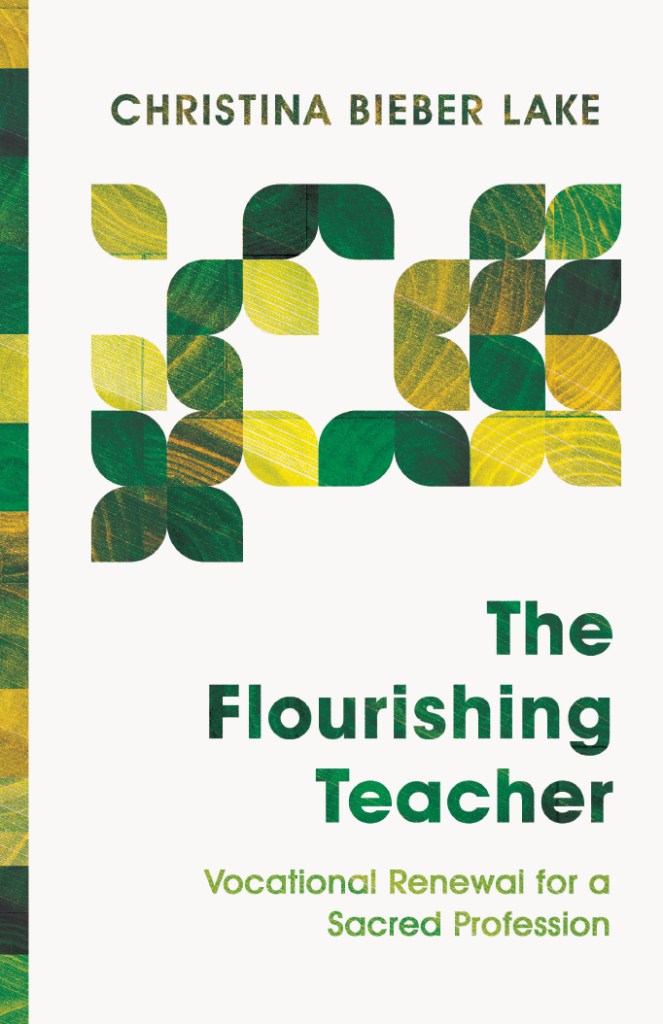
Most individuals called into the profession of teaching, I think, have an inner desire to flourish in their careers because when this is accomplished, it means their students have achieved success and thrived too. So, what is the answer to helping an educator to “flourish instead of just drag[ging] to the finish line?” In her book The Flourishing Teacher, Christina Bieber Lake offers readers insight into how she finds renewal for the sacred profession of teaching as she moves through an academic year. Lake shares, “My first goal is to help them [students] want to be in my class with each other and with me.” Setting the tone for the semester, Lake offers ideas she implements from the very start that allow both herself and her students to flourish.
Beginning her journey in August and walking us through the calendar year, Lake shares genuine and practical ideas that educators (and other vocations) can implement in order to flourish in their career. One of the richest pieces of advice to flourish, Lake shares, “The key to staying inspired to teach is to mesh your own gifts as a teacher with their deepest needs without killing yourself-or them.” Continuing on, Lake offers wisdom related to focusing on deep work and developing habits that lead to a successful career to how to organize Outlook and how to navigate the specific season of an academic career. She even includes the spiritual discipline of Sabbath and the vital role it plays in maintaining her work/life balance.
If we attempt to provide a definition for a flourishing educator, or any other profession, I’d offer Lake’s wisdom in that flourishing people are those who are “able to identify the one thing they need to accomplish and move forward in any given area, personal or vocational.” Rather than getting stuck in the mundane and the monotonous, a flourishing educator learns how to balance the demands of the calling and can find vocational renewal for the sacred profession, whether that appears in the form of how one approaches their day to how one approaches their entire career. Regardless of what profession we are called to, I firmly believe God desires that we flourish in that setting because we are serving Him when we do.
“Our lives are glaringly short and insignificant in the grand scheme of things. Even after we work very hard, the best we have to offer is a single lifetime’s worth of the harvest produced in service of a worthy purpose. And this is exactly why we are the fortunate ones. The harvest we produce can be wheat and not chaff. We get to work out obedience not to a rarified idea but to the God of love. We get to inspire young people to grow intellectually and spiritually. We get to inspire them to live their lives with integrity, faithfulness, and joy, and to remind them that though they are seeds sown in weakness, they will one day be raised in power.”
How can we encourage young people to pursue a career in such a sacred vocation? What strategies can be implemented to reduce those numbers shared above? What ideas can you offer that will benefit generations to come, so that the educators and the students flourish?
References:
Garcia, E. & Weiss, E. (2019, April 16). U.S. schools struggle to hire and retain teachers: The second report in ‘The Perfect Storm in the Teacher Labor Market’ series. Economic Policy Institute. Retrieved from https://www.epi.org/publication/u-s-schools-struggle-to-hire-and-retain-teachers-the-second-report-in-the-perfect-storm-in-the-teacher-labor-market-series/
Lake, C.B. (2020). The flourishing teacher: Vocational renewal for a sacred profession. IVP Press.
 Flourishing @ Life
Pingback: Circle Not a Square – Flourishing @ Life
Julie, I have not been able to identify why yet, but I have recognized that I feel like I am experiencing my worst semester of teaching ever!! I leave every class feeling like I blew it. I don’t feel successful after any class!!
I’m not sure if it is the added stress of dealing with covid, not being able to see faces, a self imposed expectation to make the students thrive during covid or what but I have never felt so non-thriving. Have you heard or seen others with the same struggle this semester??
I am teaching the same classes as every Fall semester, on campus.
LikeLike
April, you can include me in that lousy semester! I wouldn’t say worst, but it’s definitely not optimal! I think COVID has a lot to do with it. You know me, I love experiential activities and everything I have planned either can’t be completed or it has to be adjusted so much, that it takes away from the experience. I just want to give up. Add quarantines of students to my already small classes and it seems like instruction is continually interrupted. I will also add what I call mid-career malaise to the mixing bowl. It seems like I question, now more than ever, if this is what the Lord wants me to be doing. For the most part, I love helping students but I’m disenchanted with the sport industry, we have no athletic events for students to use as a learning platform, so it all feels so purposeless! The deeper question of the “why” continues to elude sometimes and that’s when I have to rely on my faith that the Lord has me in this season for a reason. I highly recommend Lake’s book along with two other that have been relevant for me in this season- The Slow Professor and Acres of Diamonds. You can look forward to future blog posts on these.
To anyone reading, I ask you to engage with April and I about how you keep the engagement factor in higher education. How can we thrive when we feel like we are failing? What do you do to re-engage?
Julie
LikeLike