
As an avid reader and traveler, one of my favorite quotes (as I shared in Racing to Roam) hangs on the wall in my home, “The world is a book and those who do not travel read only one page.” Because this quote blends two of my favorite activities, it illustrates for me the wealth of knowledge and meaning that is gained when engaging in one, or both, of these endeavors. For me, there is a fluid relationship between reading an author’s perspective of a particular location and experiencing a place with all of my senses; sometimes I am inspired to examine a new place as a result of my reading or I am able to revisit a place in my mind since eloquent words accurately captured a locale. Just recently, on a sunny, Spring walk through my neighborhood, I was drawn into a memory of visiting the Garden Tomb in Israel as the narrator read the vivid description from Robert Whitlow’s Chosen People. Even as I navigated the simple cove in Tennessee, my mind was transported across the ocean to a ”pleasant, enclosed garden without any religious trappings,” picturing the two wooden steps that lead into the tomb.

Whether a message appears in a work of fiction from a best-selling author or in a text from a friend, God is making me aware of opportunities to use any of my writing as an avenue for Being a Good Neighbor and loving others. Considering all of my communication through that lens, opens the door to what Gibson and Beitler call Charitable Writing-“writing that embodies the distinctive Christian understanding of love…writing that seeks to fulfill our Lord’s great ‘double commandment’ to love God and our neighbors.” Wow…did you allow that to sink in? All of my writing, whether an email, essay, assignment feedback, journal article, or a blog post, provides me with an open door to commit to Charitable Writing, a spiritual practice that “runs counter to prevalent cultural views about virtue. Consider the case of love. In our culture, we tend to characterize love as a spontaneous feeling-something that just happens to us.” But this view is not what Scripture outlines as virtuous, so if I desire that my writing be God-honoring, I must develop this virtue with “imitation and practice.”
For those of us who have spent many years amidst the brick, sometimes ivy-covered, walls of higher education, we have been subjected to academic prose that induces more sleep than insight, and more knowledge than feeling; however, a grin spreads across my face when academics like Gibson and Beitler articulate their expertise in an inviting and amusing tone. In Charitable Writing, they suggest that readers, “Talk back to this book; don’t take it as writing gospel. That process might begin in the margins of your copy, as you scribble comments and questions that our terms and claims provoke. We encourage you to share your early reflections-however tentative-with the other writers in your orbit. Test our arguments. Raise potential objections. Make connections that we haven’t ventured.” The authors demonstrate perfectly what Charitable Writing should aspire to-dialogue with others, Humble Listening to our peers, Being Curious, and engaging in a learning as a life-long spiritual practice.
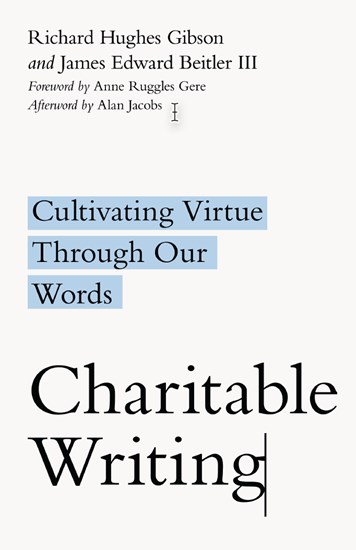
Never would I have imagined when selecting this book off the library shelf, a book I was hesitant to begin in the first place, that I was not only discovering valuable information to share with the students in class, but I was about to be challenged personally, professionally, and spiritually that seeking to live a flourishing life would need to include the spiritual practice of Charitable Writing. What I came to visualize after pondering Gibson and Beitler’s message, is that God desires for us “to ask humbly that [He] be our companion in the study, and we may trust that he will accept our invitation.” By asking God to engage with us in the process of reading and writing, we also invite Him into our hearts and minds, filling us with the needed fuel to charitably and humbly love others.
Through the spiritual practices of Charitable Writing and Humble Listening, we are offered an opportunity to establish essential skills that create a solid foundation for the Habits of a Flourishing Life, and ultimately fulfilling our life’s purpose, especially when that pilgrimage includes some type of composition, whether as a Bookworm or not! Perhaps you have an opportunity to engage in Charitable Writing through other forms such as Lasting Lyrics, an email, an academic assignment, a text, or even in a short, hand-written note to a friend or neighbor. Please feel free to share a time when Charitable Writing spoke to a deep place within your heart or brainstorm ideas for ways we can contribute to the virtue of love through writing.
References:
Whitlow, R. (2018). Chosen people. (Hope Hoffman, Nar.). [Audiobook]. Thomas Nelson.
 Flourishing @ Life
It is awesome hearing about some of the places you travel to and have been. I think and hope in my lifetime I am able to see a lot of the world as you have. The beginning of the article really caught my attention when you said not traveling is like not turning the page in a book. I want to see and experience the beauty God has created for us on earth. Thank you for your awesome articles!
LikeLike