
“End of Construction – Thank you for your patience.” These words were chosen by Ruth Bell Graham, wife of evangelist Billy Graham, for her gravestone, and they have arisen in my reading several times over the years. I’m not sure I can accurately articulate why the expression resonates so deeply within me. Perhaps the reason relates to this concept that all of the Chronos-time that God allows us here on earth should be viewed through the lens of Kairos-time, or possibly it connects more to the realization that I fail more often than I flourish at personal, professional and spiritual matters; but my hope is that those around me will consider embracing the virtue of grace when it comes to my Relational Quotient (RQ), for I imagine I will always be under construction (at least for the duration of the work on I-40 and the By-Pass).
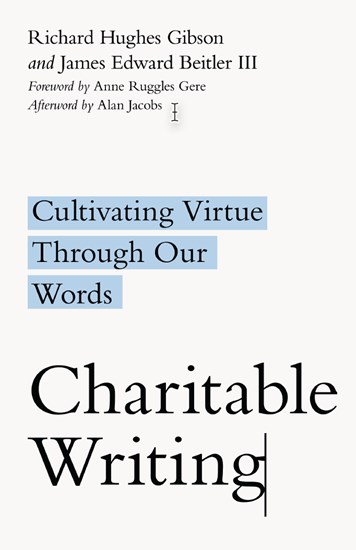
While absorbing the ideas presented in Charitable Writing, my mind drifted to this idea of construction and the Refinement and Revision process that lingers when engaging in any type of project. As I pondered the best method for communicating to my students that the assignments they submit are often in need of Refinement and Revision, and they should view the feedback as an opportunity (Kairos) to improve their essential skills rather than imagine they have failed in some way. However, when I turned this lesson inward, I grasped the reality that I am no different. When participating in the writing process, even for a blog, my desire is to produce a finished product without flaws and mistakes. But I am well aware that every item I compose will always benefit from Refinement and Revision.
Now, let’s take this concept a little deeper and see how much of Charitable Writing mirrors the process of constructing a flourishing life. If we happened to be engaged in a verbal conversation, I might ask you to identify the elements of a quality narrative, and I feel confident that we could at least come to an agreement on the basic requirement of a clear beginning, middle, and end needed even for a Simple Story. Nancy Duarte reveals to us from her research the importance of shaping a story, Brene Brown and Anne Lamott share the significance of crummy first drafts and that we must rumble with our ideas in order to move onto “good second drafts and terrific third drafts,’ and I offer that the processes employed in composing a quality essay might also be reflected in the pilgrimage to a flourishing life. We, as finite human beings, all have a beginning, middle, and end; but during those three sections, we are constantly engaging in a Refinement and Revision process.
Gibson and Beitler describe “…writing is thinking: our ideas change and develop as we go. Put another way, writing a first draft always involves setting out into the unknown…Drafting is an occasion, therefore, to cultivate and practice the virtue of hope. We write terrible first drafts in the hopes that these drafts are not the end, that our ideas will develop beyond these initial moments of composition, and the pieces we are working on may ultimately have some small part to play in reflecting the truth, beauty, and goodness of God.” Do these words not offer a perspective of a person’s journey to a flourishing life- the unknown, the need for cultivation, and the importance of practice?
“The revision stage is thus where some of the most important work of preparing…gets done. Revising well means that we seek to know our readers…By giving your time and energy, you may be able to learn what your readers’ views about effective writing are, what they know and don’t know about your topic, and what types of arguments and genres will best meet their needs.” Can you picture this same process as we navigate the effort needed to create Relational Equity within our personal, professional, and spiritual encounters?
Lastly, as we move through the various Seasons of Life, we continue to revise by refining ourselves. The construction project is not complete, but the drastic changes of the Messy Middle have faded, and now the focus shifts to the details, the Refinement, that is necessary to Finish Well. Unlike the contract with a builder, we are not provided an exact date that construction will be completed, but I am challenged to spend my time and energy Refining and Revising my life so that I can finish the race by remaining faithful (2 Tim. 4:7).
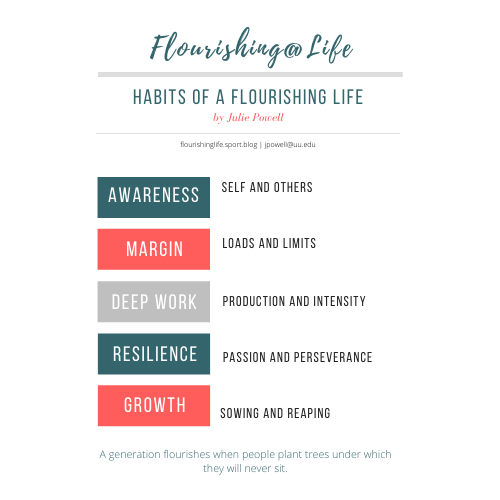
Just as students must engage in Refinement and Revision in their assignments, we are challenged to develop Flourishing Habits that refine and revise the ways in which we live our life. How has God allowed Refinement and Revision to enhance your relationship with Him and others? Please share below.
References:
Brown, B. (2018). Dare to lead: Brave work. Tough conversations. Whole hearts. Random House.
Duarte, N. (2011, November). The secret structure of great talks. [Video file]. Retrieved from https://www.ted.com/talks/nancy_duarte_the_secret_structure_of_great_talks?language=en
 Flourishing @ Life