
After walking across campus this week under blue skies and abundant sunshine, I returned to my office and reflected that there was a little more spring in my step for some reason. Again, this buoyant feeling arose while leaving the celebration of the Top Dawg Awards, even as the rain sprinkled down from above. What I had initially assumed was related to my sensitivity to the weather conditions and the love of the outdoors had also arisen on a rainy May night. For someone who is incurably curious, I wondered “What has occurred? What is different?” that allowed these feelings of contentment to emerge. It didn’t take but a short time of reflection to recognize that I had been engaged in Meaningful Conversations, with students, colleagues, and friends, without the barrier of a mask that we’ve grown so accustomed to wearing over the last year.
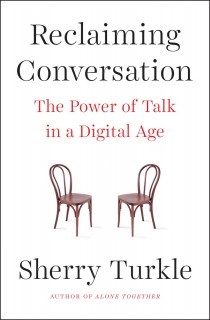
The significant events that had transpired during the week, which allowed me to feel connected to others, was the simple removal of a barrier that interfered with my ability to communicate well with others. From seeing the entire faces and expressions of my students during class, to the excitement and laughter filling the Grant Center during the celebration of our athletic program, without the physical barrier of a mask, conversation became easier and less awkward. This experience led me to think more deeply about the concepts outlined by Sherry Turkle in her book Reclaiming Conversation, where she addresses that in our current society, where we spend so much of our day engrossed with digital devices, we are distracted from conversations with others in the same way that a facemask served as a distraction for me.
Turkle shares, “Face-to-face conversation is the most human—and humanizing—thing we do. Fully present to one another, we learn to listen. It’s where we develop the capacity for empathy. It’s where we experience the joy of being heard, of being understood. And conversation advances self-reflection, the conversations with ourselves that are the cornerstone of early development and continue throughout life. But these days we find ways around conversation. We hide from each other even as we’re constantly connected to each other.” In my opinion, this need to reclaim conversation has been made more evident as a result of the isolation experienced through the COVID pandemic, where so many months passed where our devices were the only means we had to connect with others, but now that restrictions are loosening in some areas, will we return to and cherish the face-to-face conversations or be content to remain only connected with and through our devices? Personally, I must continually check my own spirit in regards to this issue, because as an introvert and thinker, it is so easy for me to remain in my own mind, losing the awareness that the lack of Meaningful Conversations may be having on my ability to flourish.
The issue that Turkle attempts to bring light to is that when we lose the ability to converse well, we also lose our ability to empathize with others which ultimately leads to conflict and division in both small and large ways. “It all adds up to a flight from conversation—at least from conversation that is open-ended and spontaneous, conversation in which we play with ideas, in which we allow ourselves to be fully present and vulnerable. Yet these are the conversations where empathy and intimacy flourish and social action gains strength.” When Meaningful Conversations are removed, we become “distracted at our dinner tables and [in our] living rooms, at our business meetings, and on our streets.”
What Turkle, and many other intelligent researchers are suggesting, and the point that I hope is being shared through many of these blog posts, is that “The moment is right. We had a love affair with a technology that seemed magical. But like great magic, it worked by commanding our attention and not letting us see anything but what the magician wanted us to see. Now we are ready to reclaim our attention-for solitude, for friendship, for society.” The removal of a facemask, the development of a Digital Philosophy, and the decision to pursue the Habits of a Flourishing Life, are leading me on a journey that I hope allows me to embrace Reclaiming Conversation in my personal, professional, and spiritual relationships.
Even on my most imaginative days, I cannot fathom what technology will enable us to do next; however, I can imagine a society that struggles to express empathy for others, for I am living in it now. However, I am encouraged to make strides to Reclaim Conversation, and I hope you will too. Please feel free to share any ideas you have which will equip us to Reclaim Conversation, whether it’s implementing an idea like Barn Raising in our classrooms to some other brainstorm that leads to change. I can’t wait to read your ideas!
Reference:
Turkle, S. (2015). Reclaiming conversation: The power of talk in a digital age. Penguin Press.
 Flourishing @ Life
Pingback: You Too? – Flourishing @ Life
Pingback: Wait, What? – Flourishing @ Life
Pingback: You Are Important – Flourishing @ Life
Pingback: Mentoring Communities – Flourishing @ Life
Pingback: Reflective Practice – Flourishing @ Life
Pingback: Hearth Places – Flourishing @ Life
Pingback: Holding Space – Flourishing @ Life
Pingback: You’re Invited! – Flourishing @ Life