
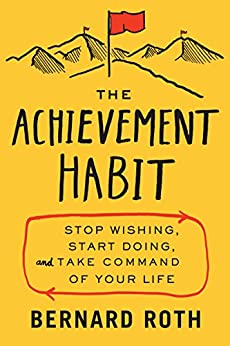
Bernie Roth opens our eyes to many of the Subtle Distinctions related to our choice of words in his book The Achievement Habit, and I will share more of his insights in Mind Over Matter, but for now, I want to see if you are as amazed as I am by what he shares. These insights can honestly have profound implications, not only in our conversations with others, but the ones that often take place in our own minds. “For our purposes it is important to understand what we do to ourselves with our own choice of words and use of language. Once we are aware of our usage, we can adjust our language to be more in keeping with our true intentions and the existential situations we are describing.”
And/But – “The existential situation almost always calls for the conjunction and, not but. Yet we often use but in place of and. This substitution is so common that it sounds correct. Unfortunately it often has the effect of changing a neutral statement into a negative one. Let’s take an example: “I want to go to the movies, but I have work to do.” The sentence uses the conjunction but to tie together two phrases: “I want to go to the movies” and “I have work to do.” Let’s assume that the existential situation is that they are both true. Then, in fact, the actual situation is represented by “I want to go to the movies, and I have work to do.” Existentially, movies and work are not in opposition. The word but is okay in common usage, and it does not reflect the true situation. When you use the word but, you create a conflict (and sometimes a reason) for yourself that does not really exist. With the word and, there is no issue. You might or might not choose to go to the movies or to work. The use of but closes off the conversation space, while and opens it up.”
Have to/Want To– “Next on our list of words to be used as little as possible is the phrase I have to. The true situation is usually best described instead by I want to…This works for just about anything, and can show you how much your own choice and desire play a role in decisions that you think are imposed on you. For example, ‘I have to breathe’ turns into ‘I want to breathe.’ Choosing to continue to breathe is a good tactic if you want to stay alive.” One variation of this Subtle Distinction is brought to light in the GO Trip Training at Union University, where instead of “I have to go to this meeting,” we instead use the language, “I get to go to this meeting.” There is something about such a little slight variation of words that transforms the mind and heart in a profound way.
Can’t/Won’t – “So, for example, if you said out loud, “I can’t stop breathing,” you would then say to yourself, “I won’t stop breathing.” The simple change of can’t to won’t is often empowering. Can’t implies helplessness; won’t signifies volition and choice.” Perhaps a student version of this one might be, “I can’t fail this test” to “I won’t fail this test.” One implies that I am unprepared and am nervous about the outcome, compared to the latter, where I may still be nervous, but I am empowered to have an impact on that grade. It is not a hopeless situation.
These are just three simple, yet Subtle Distinctions, that when we embrace a Habit of Awareness, can alter our mindsets and improve our communication with others. An intentionality with our word choice may be simple, but for me at least, it’s certainly not easy! I encourage you to share in the comments below any other Subtle Distinctions that we can make in our language choices that have the potential for significant impact.
For a humorous and exhausting perspective on interchanging words, there is an episode in season four of the Netflix series The Crown that I viewed about the same time as I was reading Roth’s book.
References:
 Flourishing @ Life
Pingback: Enjoy the Process – Flourishing @ Life
Pingback: Words Matter – Flourishing @ Life