
Stubborn streaks can arise within me, especially when it comes to certain tasks and topics where our culture is more comfortable accepting the status quo, doing what has always been done, rather than asking hard questions. Wrestling with these difficult queries, embracing the challenges that they generate, and allowing the process to unfold is an honorable approach to creating a Habit of Growth. Yet, it appears in some areas of culture, specifically in the professional setting, that the less arduous path may indeed be an easier route, but when we choose to not grapple with Big Questions, we prevent ourselves from living a fulfilling and flourishing life.
One of the topics that seems to be appearing frequently in my research here lately, which leads me to stubbornly persist with questions, relates to the topic of Measuring Success. And there appears to be an enormous gap between the standard the world is currently using to measure success and the standard that those of us who call ourselves Christ followers should be using, so my suggestion is that perhaps it’s time to Change the Metrics of what we measure to align more with God’s directives than the world’s.
In her book The Space Between Us, Sarah Anderson encourages us to Change the Metrics for how we measure success in our conversations with people whose perspectives and ideas differ from our own. “Maybe instead of “believe as I believe,” the goal can be to keep the emotional temperature of the conversation down. Maybe instead of “vote as I vote,” the objective can be to feel like both people were heard at the end. In other words, figure out what is in your power and take ownership and devote energy to that.” Here, we are encouraged to Measure the Success of a conversation by allowing everyone to share their perspective rather than persuading someone to embrace our own opinion. Here, we Change the Metric to Listening rather than speaking.
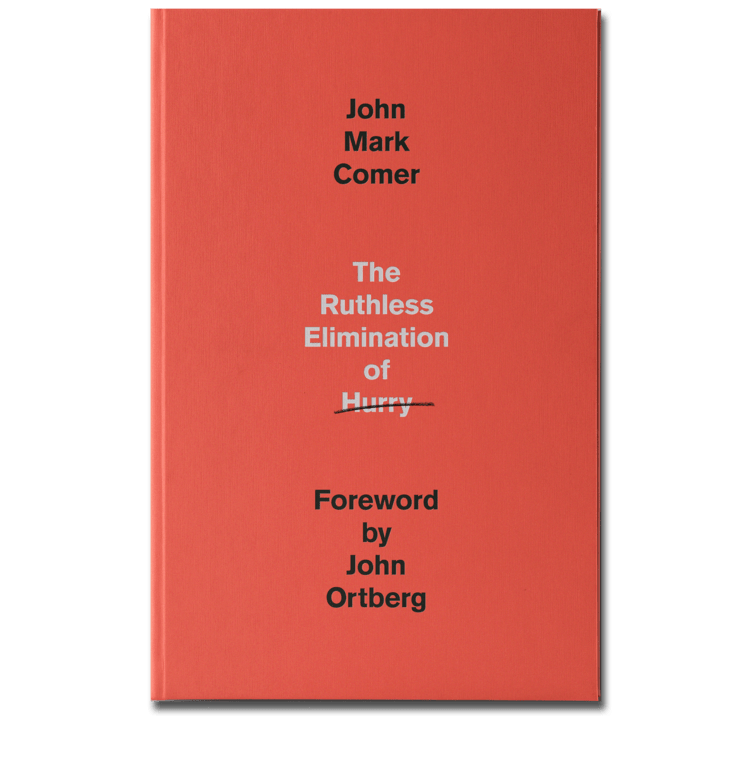
John Mark Comer asks that we Change the Metrics in what we use to define a successful career. In his book The Ruthless Elimination of Hurry, Comer shares, “I see a man who is ‘successful,’ but by all the wrong metrics: church size, book sales, speaking invites, social stats, etc., and the new American dream-your own Wikipedia page…My dream is to slow down, simplify my life around abiding. Walk to work. I want to reset the metrics for success, I say, I want to focus more on who I am becoming in apprenticeship to Jesus… the metrics for success our culture handed you might be skewed…That said ‘success’ might turn out to look a lot like failure.” Comer encourages us to Measure Success by developing a Habit of Resilience where we overcome our failures, learn from our mistakes, and uncover a better route to a successful outcome.
Grant Skeldon, in his book The Passion Generation, requests that all of us, especially those engaged with Emerging Generations, consider how we are encouraging generations coming behind us to Measure Success. “Choosing a job is a lot harder when you’re considering the amount of impact you’ll make rather than just the amount of money you’ll make. It’s easy to measure salary. It’s hard to measure impact. But studies show young people are choosing their work differently. Fifty-eight percent of millennials report they would take a drastic pay cut if they could have a job that made a difference in the world. This means the metric for choosing a career is no longer the money; it’s the calling. It’s no longer provision; it’s passion and purpose.” Perhaps, the emerging generations have something to teach the rest of us!
One other perspective comes from Banning Leibscher in his book Rooted, where he asks readers, similar to Skeldon, to consider a long-term approach to how we Change the Metrics on what we measure from the perspective of Finishing Well. Leibscher shares, “Anybody can start a race. The real question over our lives is not how strong we will begin our race to pursue God’s call but how strong we will finish it…God’s version of success is indefinitely superior to the world’s version of success. God’s version of success looks like building our lives on eternal things for eternal things…We measure our success only by numbers—numbers that measure popularity and material success…While these numbers may show us some aspects of the impact we are having, they can’t be our only measure of success…Neither appearances nor short-term success impress God. He looks at the heart, and He is looking for [Roots Before Fruits].”
There is much more to be said about how we Measure Success, how we are Keeping Score, and how we Change the Metrics to really reflect what it means to have a flourishing life, because it comes with an eternal view rather than a worldly view. How can you Change the Metrics in your life to measure more of what matters? Please feel free to share in the comments below.
References:
Anderson, S.B. (2020). The space between us: How Jesus teaches us to live together when politics and religion pull us apart. Rodney Anderson, LLC.
Comer, J.M. (2019). The ruthless elimination of hurry. Waterbrook.
Liebscher, B. (2016). Rooted: The hidden places where God develops you. WaterBrook Press.
 Flourishing @ Life
Pingback: Flourishing Mindset – Flourishing @ Life
Pingback: Fame or Legacy – Flourishing @ Life