
“I bet you don’t eat stuff like this!” This comment was made by my colleague as our paths crossed in the bakery section of our local grocery store. Within his hands, located between an aluminum tray and a plastic lid, was a Danish-style pastry with cream cheese that looked delicious. Just a brief glance into that container and my mouth was watering for a tall glass of milk and that icing-covered pastry after a few seconds heating in the microwave. As an educator who is currently teaching a nutrition course, do I dare be transparent to my colleague and admit that only yesterday, I nearly consumed an entire bag of Cheez-It Cheddar Grooves (family size)? My Junk Food tastes seem to lean more towards crunchy and salty; however, my sweet tooth enjoys being appeased every now and then too!
One of the downfalls of teaching that nutrition course is the fact that while, yes, I do indulge in Junk Food quite regularly, not only do I have the insider’s knowledge on the caloric intake of that indulgence and how many miles will be required to compensate for a lack of willpower; I am reminded of these concepts every single day that I teach! But what I hope to discuss in this post is a different way in which I introduce Junk Food into my life without regards for how it might be impacting my health and well-being. What I am currently wrestling with is this issue of balance in my life as it relates to digital Junk Food, and how many empty calories am I consuming without an awareness of its impact on my health?
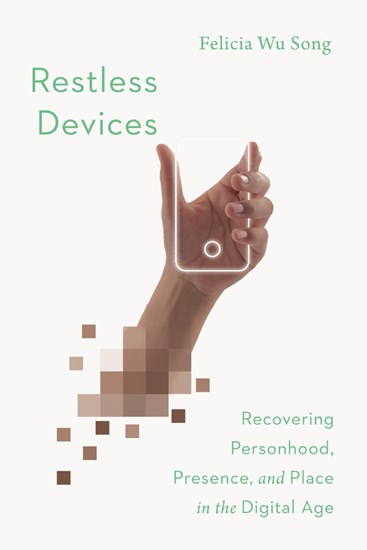
Opening the pages of Felicia Wu Song’s book Restless Devices, I am quickly reminded of how enmeshed my life is with digital Junk Food which I consume without thought to the algorithms of the platforms on the device and the “filter bubbles” in place that guide me towards what I desire. “The algorithms driving such services like Netflix and YouTube are geared to deliver to us a ‘junk food’ diet of content that our consumer selves crave. The problem is that in order for us to maintain our health, we actually need to be served with ‘veggie-type’ media from time to time in order to nurture our citizen selves.” As a naïve Gen Xer, I admit that I have embraced emerging technology all of my life and have welcomed each new convenience as it arrived without questioning much about how it might be impacting my health; but now that I can’t seem to get a break from the noise and distraction, even while pumping gas, I’m being forced to reflect on this intrusion and accept that indeed I might need to craft a personal Digital Philosophy.
Books like Restless Devices and Worldliness are throwing down the gauntlet for me as a Christ follower to consider the obstacles, such as digital Junk Food, that are preventing me from cultivating the Habits of a Flourishing Life. In Worldliness, the authors warn that “we cannot afford to take lightly the media’s pervasive presence in our lives…We must evaluate the content of media messages and the consequences of their influence…Christians of all ages have been required to soberly assess the temptations found in the surrounding culture and to respond in a God-glorifying way.” I’m afraid that I have been taking lightly this idea that the internet is “[fulfilling] its promises of equality, connection, and happiness. We have wanted to trust the tech companies to empower us for good and excuse them for their naivete when unintended consequences have gone awry…These platforms are not just ‘virtual town halls’ or a simulation of public deliberation; they are being used by agents (many of whom we refer to as ‘bad actors’) to put a finger on the scales of history and achieve massive global consequences,” challenges Song. These are deep issues that frustrate me, and I’m not even a parent attempting to navigate guiding young people through this minefield, I’m just trying to keep my own head above water!
So, what do we do about the Junk Food invading our desktops, tablets, and smartphones? How do we navigate a world of apps and sites that are more interested in profitability than in our health and well-being? The advice provided to readers of Worldliness: discernment. “Biblical discernment involves critical thinking, which often leads to costly action. It’s true that we grow in sanctification by God’s grace, but this doesn’t deny that our growth involves work.” We must be diligent to remove the digital Junk Food from within our reach, and in order to mature, “we need engaged minds asking biblically informed questions about the media’s messages and methods.”
My hope is that before I finish reading Restless Devices, I’ll have some suggestions for being in this world and not of it, but for now, I’m floundering around wondering if what I am being served is Junk Food or health food! More than likely, a little bit of both. Stay tuned! I hope you will feel free to share, in the comments below, any healthy approaches you have seen to navigating this digital world.
References:
Mahaney, C.J. (2010). Wordliness: Resisting the seduction of a fallen world. [Kindle version]. Crossway.
 Flourishing @ Life
I love this topic. I am a mother to a 15 yr old and 5 yr old. They both have access to electronic devices. My 15 yr old will stay on Tik Tok watching what I call nonsense. I finally had to put my foot down and tell her that she can watch it here and there, but she needed to read and watch things with more substance. She has downloaded some Christian eBooks to read over the summer. I want her to enjoy her digital junk food and be a teenager, but I also want to be aware that there is so much negativity out there. My 5 yr old was only interested in watching YouTube videos about the craziest things. I downloaded ABC Mouse and other educational games. She loves them. I don’t have to worry about her seeing anything inappropriate and she is learning in a fun way.
LikeLike
I enjoyed reading this post! As a college student, I know I fill my life with things that are “empty calories” and there are so many ways now with technology to easily do that. I think it is interesting that you point out these things are not looking out for our health and well-being, and anything that is not looking out for us we should remove from our lives. I think one healthy approach is finding other ways to fill empty time with things that are looking our for our well-being, whether that be surrounding ourselves with people we know are looking out for us and encouraging us rather than the opposite, or finding something fulfilling to do instead.
LikeLike
Pingback: Don’t Think – Flourishing @ Life