
In that photograph, the person is facing left, so please be sure to place that one on the right side of the page so your eye travels to the gutter. Perhaps only someone schooled in Yearbook Lessons can make sense of those guidelines, but personally, that particular tidbit has arisen too many times in my life to keep a running tally. From yearbook staff in high school to athletic communications to a direct sales business to slideshow presentations for college classes and professional workshops to an online blog, this simple advice is ingrained into anything visual that comes from my hands.
This need to be intentional about where an eye is drawn is only one of the many essential skills that found their roots during those moments of being a part of the yearbook staff. So, thank you, especially to Beth Mohon, Johnny Cole, and the instructors of our yearbook boot camp. Who knew how often that information would come in handy over the course of a career! In a pre-internet world, we were taught to focus on good visuals and design. We sought to use both text and photos to tell a compelling story. For we had the weighty responsibility of capturing the history and memories of our classmates so there would be a written account of our experiences that would stand the test of time. And as I sit here researching data storytelling, I find myself treasuring these Yearbook Lessons even more, as I see these abilities to be just as relevant today, if not more so, in a world of screens and devices.
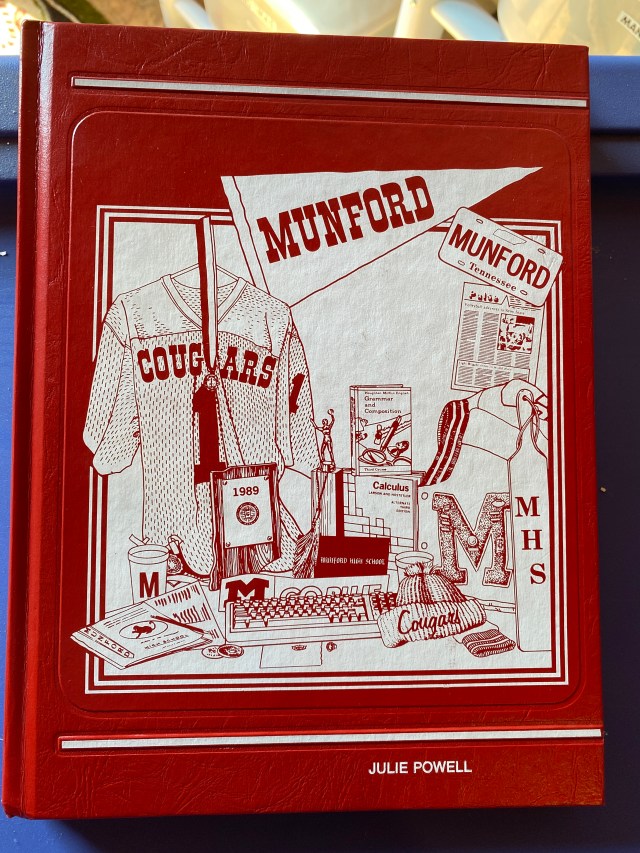
With a desire to equip students so they feel confident and prepared for life beyond college, it is necessary, at times, to stop and consider if there are additional skills that can be taught that run parallel to specific discipline concepts—a value-added plus to enrolling in our course. Perhaps it’s these Yearbook Lessons that have me contemplating how to instruct students in good layout and design, or encouraging the acquisition of digital skills, because although emerging generations are considered to be digital natives, they appear to be lacking in understanding the processes and the why behind the applications they are using. They just know how to use them. But in today’s culture, they will be required to design flyers, posters, social media banners, organizational logos, and more. For students outside of a major in art or communication, where will these skills be acquired?
Perhaps I am foolishly concerned with where our students will gain knowledge of things we do not directly teach, perhaps these are issues for on-the-job training, but I wonder if I might be missing some valuable opportunities. Many disciplines are very skilled at teaching the extensive knowledge in that field of study, but it is only through personal discovery that we acquire even a basic skill at visual presentations. So, I was extremely intrigued this week as I read through Storytelling With Data, because in combination with discussions on how to promote our majors to potential students and evaluating a colleague’s online course, the importance of my Yearbook Lessons began to emerge. In addition to comprehending the importance of design elements such as using shades of black, font selections, and effective use of white space, I began to ponder the other benefits of serving on the yearbook staff: time management with deadlines, budgetary limitations, project management, gathering information, photography, accountability and responsibility, and so many life skills too numerous to list here. So, I return again to the earlier inquiry—where do emerging generations gain the essential skills that will enable them to flourish at life—personally, professionally, and spiritually?
Perhaps these questions only plague those of us in higher education (or just me), but I think we encounter design flaws every day. “We aren’t naturally good at storytelling with data…no one teaches us how to tell stories with numbers. Adding to the challenge, very few people feel naturally adept in this space.” So, again, where are these skills attained if you aren’t the beneficiary of Yearbook Lessons? Knaflic reminds us, “Technology has enabled us to amass greater and greater amounts of data and there is an accompanying growing desire to make sense out of all this data. Being able to visualize data and tell stories with it is key to turning it into information that can be used to drive better decision making.”
Whether it’s a graphic design element of a pastor’s message or an unreadable yard sign, we encounter the need for effective visuals all the time. As our society gathers more and more data with every click and tap, we need people skilled at forming a compelling story from that data, both visually and textually. So, I will forever be grateful for my experience with Yearbook Lessons! Do you have a similar example of where you learned essential skills in an unexpected and unique place? Please consider sharing in the comments below.
Reference:
 Flourishing @ Life