
Except for some disappointment that one area of my life did not really turn out as I had once dreamed, I would mostly describe myself as an optimistic, hopeful, glass-half-full type of person. However, without a clear explanation as to what has changed in the last few years, I’m experiencing a bit of a struggle when attempting to cultivate a Grateful Disposition that leads down the path to a flourishing life. In an effort to derail this trajectory to a Whiny Disposition, I’ve been researching what it means to truly embrace a biblical perspective on thanksgiving, to cultivate the Vanishing Virtue of gratitude for personal, professional, and spiritual health. And after three or four presentations on this particular topic, I still find myself grappling to understand why grumbling feels so much more natural than gratitude.
Enter Dustin Crowe’s book entitled The Grumbler’s Guide to Giving Thanks which includes a short gratitude quiz that is extremely helpful, by the way. Not only does Crowe provide excellent content to strengthen the Cultivating Gratitude presentation for this summer, but he doesn’t shy away from the reality that even Christ followers sometimes find it difficult to always be thankful, especially in the storms of tough circumstances. So, Crowe walks readers through his process of evolving from Grumbling to Grateful for several reasons: (1) it’s a glaring need in our lives; (2) he desires to address giving thanks biblically; (3) thanksgiving leads to knowing God deeper; and (4) it cuts off the food supply to ingratitude and idolatry.
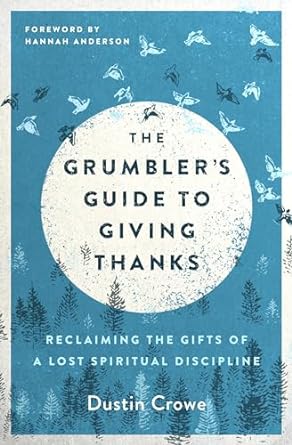
Similar to my own personal experiences, Crowe shares how tricky it is to maintain this Attitude of Gratitude for extended periods of time. Many of us experience a shift in our hearts when we embrace practicing gratitude with specific exercises like a gratitude journal, but how do we navigate a lifestyle where thanksgiving becomes an everyday habit? Honestly, we can’t succeed without help! “While grumbling is natural, gratitude is supernatural. We need God’s help. Gratitude goes against the grain of our hearts. It takes work. Developing the reflex of thanksgiving takes time and effort. But stick with me; the payoff is worth it. God wants this for us.”
I think what resonates most for me in the effort to transform from Grumbling to Grateful is Crowe’s perspective that this concept is more than simple “over-the-top optimism,” it’s about being honest about the challenges and obstacles that life brings. He doesn’t ignore our human nature, but he does encourage us to “find more reasons to be grateful than to grumble…Thanksgiving must shift from a once-a-year emphasis to a persistent practice.” In my thinking, he connects this transformation to all Five Habits of a Flourishing Life: Attentiveness, Deep Work, Growth, Margin, and Resilience.
Personally, maintaining habits such as Saying Grace and speaking the words “please” and “thank you,” that were established in childhood is a great place to start. It’s one of the reasons I love that at West Jackson, Butch Hawks has always taught the preschoolers to sing that “please and thank you are the magic words.” These biblical habits started early in life are always easier to return to than to start new as an adult. Crowe recognizes, “We won’t always feel thankful, and we won’t always embrace with open arms everything God allows into our path. But biblical gratitude is gritty gratitude.”
Gritty Gratitude means, “We should cultivate gratitude to God…But giving thanks doesn’t require experiencing gratitude first. Even if discouraged, empty, or struggling to rest where God has us right now, we can give thanks because hope in Him outweighs our momentary experience.” So, in closing, if you want to join me in transforming from Grumbling to Grateful, let’s take to heart Crowe’s suggestion, “Pursue things that stir up gratitude. But don’t wait for a mood of gratitude to strike you before giving thanks. More often than not, the action helps quicken the emotion.” And please do not forget this advice: “As hard or frustrating as circumstances might be, God will use it for good. That’s a fact. The Bible doesn’t say God might or could use hard things for the good of His people; it says He will do this (Rom. 8:28; Eccl. 8:12).”
Reference:
Crowe, D. (2020). The grumbler’s guide to giving thanks: Reclaiming the gifts of a lost spiritual discipline. Moody Publishers.
 Flourishing @ Life