
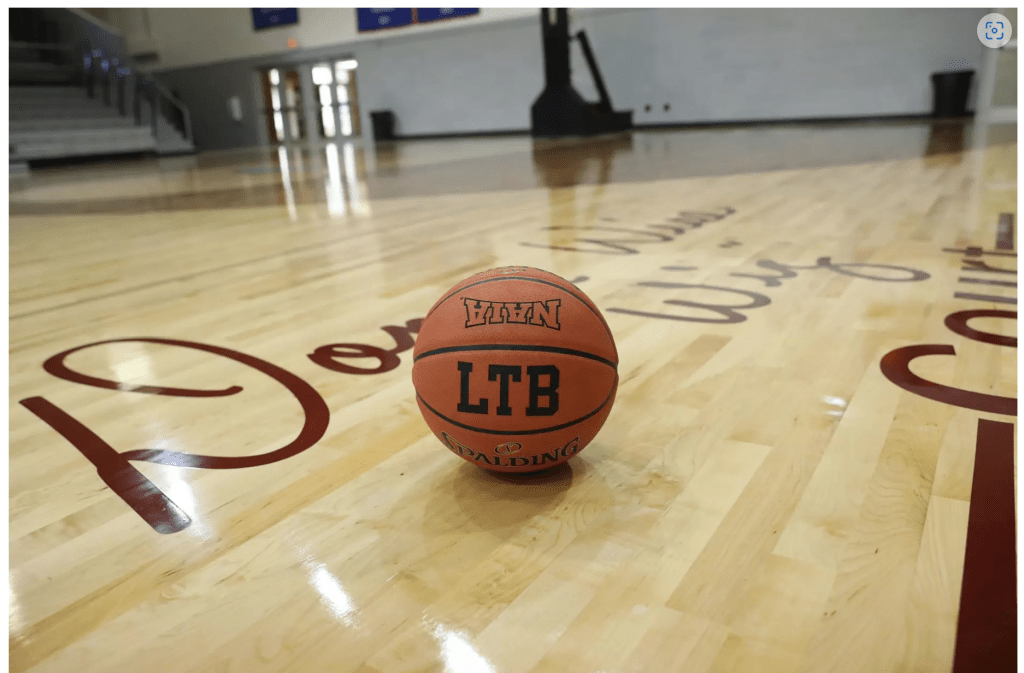
The scorebook does not hold the significance it once did in the game of basketball as more emphasis today is placed on the use of video review and computerized statistics to keep track of what is happening on the floor; however, I still enjoy the duties of being the official scorer. And when you are the newbie on the table and your skills are perhaps rusty and untested, you understand that the scorebook may be scrutinized by others to ensure that you actually know what you are doing. Luckily, everything seemed to go smoothly my first night scoring on Donna Wise court, but there is one element that I mark differently than most and that is the jump ball.
For non-basketball fans, when two players tie for possession of the ball, the referees will whistle a jump ball. The possession alternates between teams when this occurs, and at other specific times in the game, so it’s necessary to keep track in the scorebook of when this happens. Nearly 40 years ago when I began scoring basketball games, the newspaper reporters often utilized the scorebook to tell the story of what happened in the game, so they needed to know who gained possession of the ball, so that’s what I learned to write into the scorebook. According to the instructions in the front of a scorebook, this approach is backwards. The alternating possession should actually read which team receives the next ball, not the one who gained possession of it. This basketball example is not the only time when I have (or will be) accused of Backwards Thinking.
If someone utters the phrase “that is some Backwards Thinking!,” it’s not likely a compliment, as it is meant to express disagreement or surprise at an idea that seems illogical or contrary to common sense. Welcome to how my brain always works—Backwards! However, I propose there are specific moments when a Backwards Thinking brain is precisely what is required to move forward towards an intended outcome. And two timely reminders of this need are presently occurring in my life. The first example is in designing a college course and the second is in considering the flourishing life that God desires for us.
When crafting a college course, it is Backwards Thinking, or reverse design, that can be our best guide to navigating where a course may go. This concept, first introduced to me in 2014 by Ann Singleton in a course redesign workshop, is being utilized once again in 2024 as a transformational tool to reflect on who we desire our students to be once they have completed a particular course in our curriculum. Therefore, we begin at the end and think Backwards about what students need to learn throughout the weeks of the course to demonstrate mastery of the learning outcomes. It is in completing Dee Fink’s significant learning goal that insight is gained in how to best approach assignments and assessments— “A year (or more) after this course is over, I want and hope that students will _____.”
This same Backwards Thinking approach has other applications. As we’ve moved through a series entitled The Good Life at church this month, I could not help but find parallels to what was shared in the post Flourishing Thinking. Perhaps if we considered what it would look like to model our lives after Christ and work Backwards from the example He sets for us, we’d find navigating our way to the abundant life He promises a little more clearly. Consider altering Fink’s statement a bit from a classroom setting to a life setting, “Twenty years (or more) into this life, I want and hope that my life _____.”
As Michael Todd encourages us in his book, whether it’s relationship goals or life goals, we must know the target for which we are aiming. If my life goal is to serve a loving Savior by pouring my life into others so that the abundant and flourishing life God promises becomes real, then I must work Backwards from His example, examining where I may need the Spirit to work on my heart, so that I might indeed live in the God-Given Space made just for me.
From a basketball scorebook to course design to life planning, there might just be a need for Backwards Thinking sometimes, which is a good thing because sometimes that is the only way I know how to operate. Are there other examples that come to mind when Backwards Thinking is needed? If so, please consider sharing in the comments below.
References:
Fink, L.D. (2003). Creating significant learning experiences: An integrated approach to designing college courses. Jossey-Bass.
Gilbert, E. (2024, November 3). The good life: Embracing thankfulness. 3Trees. Retrieved from https://www.youtube.com/watch?v=5ohu1rEbrwo
Todd, M. (2020). Relationship goals: How to win at dating, marriage, and sex. Waterbrook.
 Flourishing @ Life
Pingback: R&D – Flourishing @ Life