
Think back to a moment in your life that felt Surreal. How would you describe it to others? Maybe you were piloting a Bonanza without instruments, standing over the edge of a cliff in the Grand Canyon, or witnessing something transpire that could only be explained through the supernatural existence of a divine and holy God. Even the best writers sometimes struggle to capture such experiences in words.
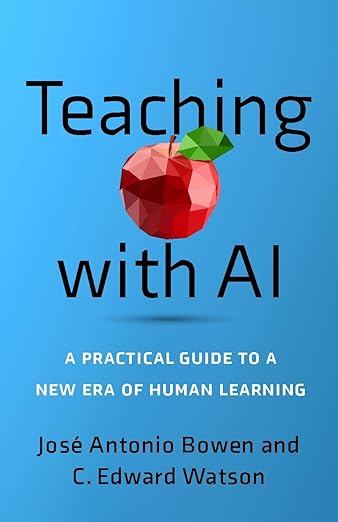
Mysteries abound when entering Uncharted Territory and this week’s Surreal Experience with AI (Artificial Intelligence) is challenging to put into words. Choosing to place my trust in the research of Bowen and Watson in their book Teaching With AI, I utilized their prompts to assist in the preparation of course materials for the spring semester. While I had previously used AI for class discussion and assignment ideas, I had never fully trusted it to replicate the depth of human experience gained from decades in higher education. However, to conduct the R&Dnecessary to guide my students in acquiring essential skills for success Beyond College, I needed to embrace a bit of Controlled Floundering and see what AI could teach me.
Allowing AI to make suggestions was challenging. I’ve spent decades investing personal and organizational resources to gain expertise in my field. Relying on tested methods, whether successful or not, has been fundamental. While research on pedagogy and transformational teaching has been crucial, AI has the potential to condense years of experience and countless teaching workshops into tools that can help less experienced instructors create content and courses that once took years to develop. How does someone in the Post-Season of their career navigate this unknown?
As a member of the Forgotten Generation, I’ve spent my entire life adapting to new technologies like computers, tablets, and smartphones. Yet, this feels different. Despite the Surreal feeling, it aligns with my long-standing efforts to promote a Generational Remix and help younger generations develop a Digital Philosophy. We must meet students where they are, strive to understand them, and create classrooms that prepare them for the future. How can I address their needs if I’m unwilling to experiment with AI?
This Surreal Experience also had a creep factor, as a colleague once described. Although her reference was about workplace culture, it aptly describes my feeling when I asked AI to write a blog post on Cancel Culture. Except for one inaccurate descriptor, the AI’s writing mirrored my style and tone, crafted an appropriate call to action, and integrated my faith as I do in my daily life as a college professor. It was both creepy and Surreal.
Psychologist Julia Shaw’s research, citing McAndrew and Koehnke, explains this “creep factor.” They found that creepy characteristics often make us fearful or anxious and are seen as part of an individual’s personality rather than just their behavior. Unusual patterns of nonverbal behavior or odd emotional responses can trigger our “creepiness detector,” making us more vigilant as we try to determine if there is something to fear. This reaction can also apply to AI.
Despite the lingering wariness, I will press on to see what lies ahead. Bowen and Watson share, “The possibilities are overwhelming, real and evolving quickly. This is a moment we have experienced before. It was impossible to imagine how the internet would change our lives, even though the dot.com book was only a few years away. Still, the way to get better at everything is to get better at something. You will find that not every task can be done better or faster with AI, but thankfully, it is easy and quick (and mostly free) to try.”
So, I will see if AI can help craft effective and meaningful courses this spring. It may be a Surreal Experience, but I cannot expect my students to Follow Where You’ve Been because none of us have been here before!
References:
Bowen, J.A. & Watson, C.E. (2024). Teaching with AI: A practical guide to a new era of human learning. Johns Hopkins University Press.
Shaw, J. (2019, June 4). What makes a person creepy? And what purpose do our creep detectors serve? A psychologist explains. TED Conferences, LLC. Retrieved from https://ideas.ted.com/what-makes-a-person-creepy-and-what-purpose-do-our-creep-detectors-serve-a-psychologist-explains/
 Flourishing @ Life
Pingback: No Square Inch – Flourishing @ Life