
In 1985, teenager Marty McFly hopped into a DeLorean and rocketed back to 1955 thanks to the eccentric brilliance of Doc Brown. Decades earlier, Orson Welles’ 1938 radio broadcast had sent listeners into a panic, believing aliens had landed in New Jersey—a moment that raised enduring questions about media influence and ethics. More recently, television shows continue exploring this human fascination with time—transporting characters across centuries and asking us to imagine the “what ifs” of history and possibility.
Maybe I’m an overthinker, or maybe there’s a small philosopher living inside me, but I often find myself rationalizing the fictional details. For instance, if someone traveled from 2025 to 1814, we rarely consider the basic challenges they’d face: How do you start a fire? Make herbal medicine? Build shelter? Sew clothing from scratch? We gloss over the survival skills and instead focus on something deeper—our need for Anchored Hearts, for something solid that grounds us when the unfamiliar feels overwhelming.
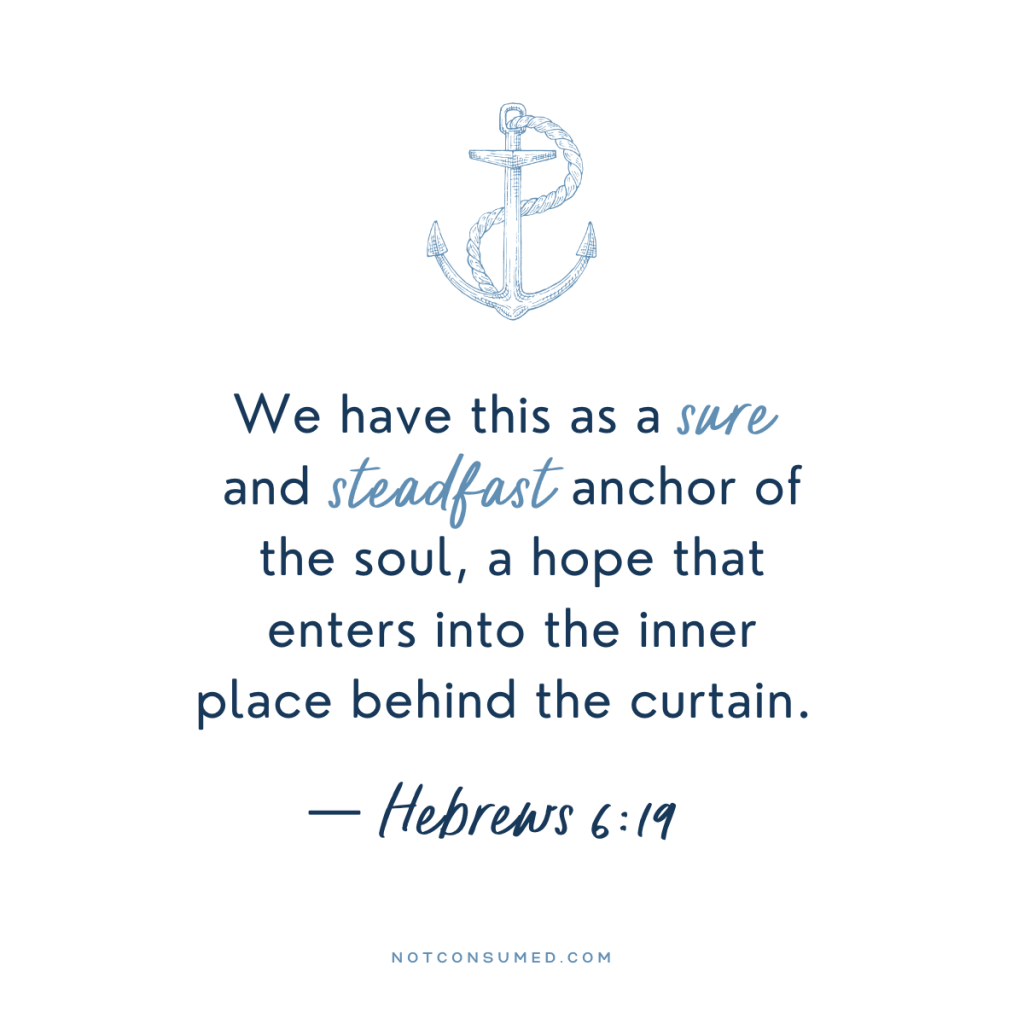
In these time‑travel dramas, physical landmarks often serve as Anchors for the disoriented traveler: a ring of stones in a meadow, a small pond hidden among trees, or a weathered homestead on the hill. These places help characters regain clarity and orientation. Pastor Levi Lusko explores a similar concept in his series Touch Grass, highlighting the importance of engaging with creation when our lives feel disrupted or off‑center. He reminds us how God designed the natural world to calm our bodies and minds—whether we’ve spent too many hours behind screens or we’re battling literal or emotional jet lag. Simply stepping outside to “touch grass,” or practicing something like Forest Bathing, helps us recalibrate.
But there’s more—much more. Beyond the gifts found in nature, we have access to the greatest Anchor of all: Jesus Christ. If I ever found myself rising out of a pond into a past century, physical landmarks and familiar faces would certainly help. But the truest, most reliable Anchor for my heart—especially in uncertainty—is available anywhere, anytime, in any era.
In teaching about Anchored Hearts, Lusko points us to Scripture—a place where we encounter “an old truth that doesn’t need updating, that doesn’t need changing.” In a culture that shifts daily, we don’t need a new playbook. We already have God’s unchanging Word, which steadies us when everything else is in motion.
This is why letters like 1 John are so powerful: they help us discern “the difference between real and fake.” Whether we’re caught up in the twists of a TV drama, questioning the authenticity of breaking news, or overwhelmed by personal circumstances, the solution isn’t found in speculation or escapism. It’s found in cultivating Anchored Hearts—hearts tethered to Scripture and to Christ Himself.
When our world feels unfamiliar or fast‑moving, we don’t need a time machine, a stone circle, or a hidden pond. We need the One who is constant, steady, and unchanging. And He is with us in every moment, every season, and every story.
As you step into the rest of your day, I invite you to pause and intentionally Anchor your heart. Touch grass. Step outside. Open Scripture. Pray. Notice the steady presence of Christ in the middle of your own fast‑moving world. Don’t wait for a crisis, a transition, or a moment of disorientation to look for your true landmark—choose today to build rhythms that tether your soul to the unchanging truth of God’s Word. Let this be your next step: identify one simple practice you can begin this week that helps you stay grounded, attentive, and anchored in Jesus. Your heart—and your future self—will thank you.
References:
Lusko, L. (2025, August 11). Something old, something new. Touch Grass Series, Part 1. Fresh Life Church. https://freshlife.church/messages/something-old-something-new/
 Flourishing @ Life