
Production and Intensity
Cal Newport introduced us to deep work in the post entitled Attention Residue, but now we will explain the Deep Work Hypothesis which states, “the ability to perform deep work is becoming increasingly rare at exactly the same time it is becoming increasingly valuable in our economy. As a consequence, the few who cultivate this skill, and then make it the core of their working life, will thrive [flourish].” The Habit of Deep Work embraces a rhythmic philosophy which “argues that the easiest way to consistently start deep work sessions is to transform them into a simple regular habit.” Newport continues to emphasize the importance of deep work for us to be able to learn and learning connects to the Habit of Growth. And in order for a person to produce at their peak level, they “need to work for extended periods with full concentration on a single task free from distraction. Put another way, the type of work that optimizes your performance is deep work.”
One of the most significant obstacles to the production of deep work is what is known as “Shallow Work: Noncognitively demanding, logistical-style tasks, often performed while distracted. These efforts tend to not create much new value in the world and are easy to replicate.” To understand shallow work, just consider how much time in your day is spent answering messages, surfing the web, or watching television. All of these tasks are necessary, but a problem arises when those tasks become a distraction to deeper work. “Deep work should be a priority in today’s business climate. But it’s not. [Newport] summarizes various explanations for this paradox. Among them are the realities that deep work is hard and shallow work is easier, that in the absence of clear goals for your job, the visible busyness that surrounds shallow work becomes self-preserving, and that our culture has developed a belief that if a behavior relates to the ‘Internet,’ then it’s good-regardless of its impact on our ability to produce valuable things. All of these trends are enabled by the difficulty of directly measuring the value of depth or the cost of ignoring it.”
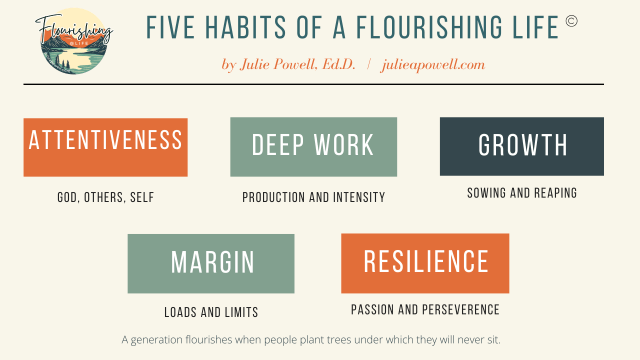
Developing a Habit of Deep Work is critical to a flourishing life, not only in the professional realm but also in the personal when considering important attributes such as creating relational equity with those around us (horizontal relationships) and a healthy spiritual life (vertical relationship). At a later time, I will address more in-depth the concept of flow, but the idea is that humans can enter this mental state where focus is acute. One might hear an athlete who has a stellar performance describe “being in the flow” of the game where deliberate practice rewards itself with what feels like an effortless attempt to succeed. Flow activities “have built-in goals, feedback rules, and challenges, all of which encourage one to become involved in one’s work, to concentrate and lose oneself in it.” The hope is that a Habit of Deep Work allows one to “build [their] working life around the experience of flow produced by deep work” which is “a proven path to deep satisfaction.”
Newport continues by offering arguments for depth based in neurology, psychology and philosophy, while establishing three rules for deep work: (1) work deeply; (2) embrace boredom; and (3) quit social media. Approaching deep work from the field of neurology, Newport offers Gallagher’s grand theory which “tells us that your world is the outcome of what you pay attention to, so consider for a moment the type of mental world constructed when you dedicate significant time to deep endeavors…if you spend enough time in this state, your mind will understand your world as rich in meaning and importance.” The argument from a psychological perspective explains the concept of flow which was described earlier. Finally, the philosophical argument suggests, “Whether you’re a writer, marketer, consultant, or lawyer: Your work is craft, and if you hone your ability and apply it with respect and care, then like the skilled wheelwright you can generate meaning in the daily efforts of your professional life.” Now, consider how developing a Habit of Deep Work connects to the other Habits of Flourishing. In order to produce deep work, it will be important to have a Habit of Awareness where you understand which environments nurture yourself and others. Understanding the time commitment for shallow work allows you to create the Habit of Margin,while learning how to stick with a project develops a Habit of Resilience. Ultimately, the creation of deep and meaningful work allows the Habit of Growth to emerge where a person can reap and sow the fruits of their labor which can potentially lead to a flourishing.
 Flourishing @ Life