
Recently, a friend and fellow sport professional, recommended the book entitled Humble Inquiry by Edgar Schein to me. Although the initial approach to this volume was an effort to offer guidance for emerging adults as they prepare for a professional career in sport, the lessons offered within are valuable to everyone in any setting and in all seasons of a vocation. The insight Schein offers into creating positive relationships and effective organizations aligns nicely with the themes of this blog and can prove beneficial to those who desire to create relational equity.
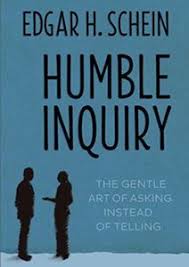
To apply the principles Schein outlines, it is worthwhile to comprehend what he terms “humble inquiry” which is “the fine art of drawing someone out, of asking questions to which you do not already know the answer, of building a relationship based on curiosity and interest in the other person.” With this definition, I see connections to the previous two posts about Ehman and McHugh’s approaches to being others-centered by offering deep attention to those around us. Not only are we challenged to listen more, a layer to deep listening is added when we become better at asking questions too.
“Why is it so important to learn to ask better questions that help to build positive relationships? Because in an increasingly complex, interdependent, and culturally diverse world, we cannot hope to understand and work with people from different occupational, professional, and national cultures if we do not know how to ask questions and build relationships that are based on mutual respect and the recognition that others know things we may need to know in order to get a job done.”
Schein offers an excellent example to the importance of asking the right questions with the correct attitude when describing the significance of efficient communication among a staff of doctors and nurses in an operating room. If we are the patient vulnerable in the hands of these professionals, we desire effective communication from all parties involved as it could mean life or death. In a less critical example, Schein discusses different possibilities and outcomes in communication between athletes when passing a baton in a race. Regardless of the setting one finds themselves, Schein proceeds to outline three things one must improve: “(1) do less telling, (2) learn to do more asking in the particular form of Humble Inquiry; and (3) do a better job of listening and acknowledging.”

If educators, leaders, and mentors desire to equip emerging adults with useful skills, we might need to consider teaching Humble Inquiry as being a distinctive approach from “leading questions, rhetorical questions, embarrassing questions, or statements in the form of questions.” Humble Inquiry is based on curiosity and interest rather than the approach we sometimes take in education when attempting to discern gaps in knowledge. In Humble Inquiry mode, “exploratory questions that minimize my telling and maximize letting the other person tell his or her story in as unbiased a way as possible” is implemented.
Attempting to make a switch from telling mode to listening mode is not an easy endeavor. “When we are in telling mode, we hope to educate, to impress, to score points, to entertain; when we are in the listening mode, we want to be educated, impressed, and entertained.” Even in honest efforts to guide a student/employee to a successful outcome, an educator/supervisor may find it easy to slip into sharing their own experiences rather than listening humbly. With the emphasis here in the US on “task performance, interpersonal competitiveness, and telling rather than asking, it makes it more difficult to be humbly inquiring because that may show weakness and, in fact, makes one vulnerable. But, paradoxically, only by learning to be more humbly inquiring can we build up the mutual trust needed to work together effectively and open up communication channels.”
Transforming my attitude to one of humble inquiry will take a great deal of determination because my default is to share personal experiences and hope that the information is useful to the audience; however, as we discussed in Follow Where You’ve Been, the experiences of my generation and those of Gen Z aren’t always similar, and if the one listening has no framework of reference, telling of my experiences is unproductive.
Whose name does your brain summon when you consider a person who is talented at asking humble questions? Is there someone you know that flourishes at slowing down and building trust with others? What characteristics do you desire to emulate that is in alignment with this concept of Humble Inquiry? Please share in the comments below.
 Flourishing @ Life
Pingback: Others-Centered in a Self-Centered World – Flourishing @ Life
I think this is a fantastic article. This specifically spoke to me because this is something I have been learning about in my own life as I dive into professional sales and financial planning. Recently, my dad has been walking me through the importance of asking questions and being quick to listen. After reading this post, I would love to read this book. I like how it talks about the difference in sharing personal experience and listening humbly. Personally, I am quick to share my own personal experience thinking it will be helpful to the person listening, but in reality, I have found that listening to the other person is much more helpful to not only me, but most importantly to the person I am meeting with. I think the insight you have provided within this post is helpful and encouraging for not only my life but many others who will get to read this. Thanks so much for this insight!
-Eli Parker (PEWS 327)
LikeLike
This is a fantastic article. This spoke to me because my parents have always told me that I have two ears and one mouth for a reason. Meaning you should listen twice as much as you speak, and I’ve been trying to practice this more as I have gotten older. When you ask questions to someone else, you should genuinely be interested in what they have to say in response to your question. Don’t just ask them the question for the heck of it, genuinely be interested or don’t ask them anything to begin with. I also agree that it’s difficult to switch from telling mode to listening mode.
LikeLike
I really enjoyed reading this article! I personally had never heard of the book, Humble Inquiry by Edgar Schein. I have talked to a lot of people throughout my life on how to be successful and how to reach my goals. Almost all these people have had the same answers, make connections. This article not only talked about the importance of these connection but how to make those connections. For the most part, I have always been told to go tell them about me and my story, but this article says the opposite. To make those great connections you must have questions and listen to their answers and their advice. The three things Schein says people need to improve are do less telling, do more asking, and do a better job of listening and acknowledging. I need to learn from these things and apply them to my life to be able to be successful and fully reach my dreams.
-Ashley Graves
LikeLike
I feel like its just always a good thing to be humble and sit back and be observant and just see what you can learn from people around you, My mom always told me that I was a very observant person and I feel like I do just sit back and listen. Also it’s always nice to be a gentle person and continue to be humble.
‘
LikeLike
Pingback: Are You an Energy Vampire? – Flourishing @ Life
Pingback: Check Gauges Light – Flourishing @ Life
Pingback: I Sliced Instead of Peeled – Flourishing @ Life
Pingback: Stuck Pause Button – Flourishing @ Life
Pingback: Courageous Conversations – Flourishing @ Life
Pingback: Probing Conversations – Flourishing @ Life
Pingback: Confirmation Bias – Flourishing @ Life