
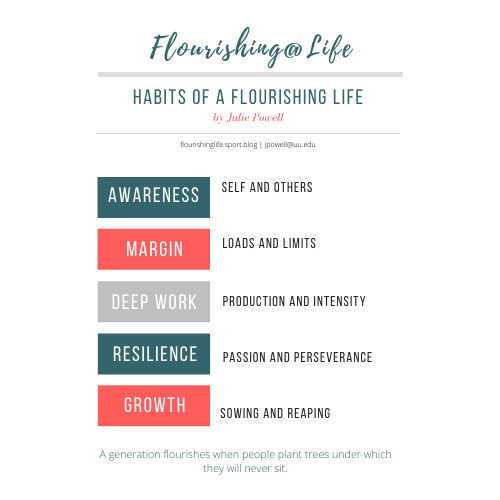
Loads and Limits
Several years ago, fellow Union professor Hayward Armstrong recommended a book to me entitled Margin: Restoring Emotional, Physical, Financial, and Time Reserves to Overloaded Lives by Richard Swensen in relationship to a nutrition course. Today, not only do I return to the wisdom Swensen provides, but his use of the word flourishing sealed the deal! Encouragement to develop a Habit of Margin in our lives occurs as a result of the wealth of acquaintances and friends around me who have no room in their lives for investments that can potentially lead to a flourishing life. Swensen shares, “Margin is the space between our load and our limits. It is the amount allowed beyond that which is needed. It is something held in reserve for contingencies or unanticipated situations. Margin is the gap between rest and exhaustion, the space between breathing freely and suffocating. Margin is the opposite of overload.” My observation is that flourishing people have margin in their lives which allows the space to live a listening life, love their neighbors, and create relational equity.
Honestly, I wish everyone would take the time to read this book because my attempt to offer a summary on margin will fall short on the wealth of information Swensen provides. One of the interesting aspects related to Swensen’s insightful work and developing a Habit of Margin is that his book was published in 2004. Sixteen years later, his perspective on needing margin in our lives is still relevant, and possibly even more critical today as many researchers express concern over technology and how it is diminishing margin in our lives. Technology that was created to save time is now absorbing our time and finding a balance is becoming more and more challenging. “We have comforts and conveniences other eras could only dream about. Yet somehow, we are not flourishing under the gifts on modernity as one would expect.”
In addressing the notion of limits, Swensen explains, “All things have limits-people, governments, buildings, bridges, brains, and organizations. Even more subjective things such as friendships, creativity, adaptability have limits. If we are well within boundaries, we can be expansive and growth-oriented [Habit of Growth]…Now that we have exceeded so many of our limits-personal, emotional, relational, physical, financial-we have no margin at all.” When a person approaches or exceeds their limit, stress pollutes their life. One of the greatest challenges in creating appropriate boundaries is that each one of us not only have different loads and limits, the areas where we need to set limits will vary from person to person. Developing a Habit of Awareness can assist not only in setting boundaries for ourselves, but it can also create mindfulness of the loads and limits of those in our sphere of influence, be it personal or professional relationships.

Swensen’s approach focuses on the four areas mentioned previously: emotional, physical, financial, and time; however, I would encourage us to examine all areas of our lives where we truly desire to flourish and recognize the loads and limits critical to avoiding marginless living. It’s possible to use Swensen’s four as umbrella categories and then arrange a list of our own areas below. Whatever system works best for you, use it. It’s all about understanding the need to develop a Habit of Margin. Below I will offer some examples from Swensen to help us have a concrete understanding of margin versus marginless living. Please feel free to add areas where you might struggle with finding margin in your life outside of the ones mentioned here or share how you determined a way to live this modern life with a Habit of Margin.
Which category describes your life?
Marginless: “being thirty minutes late to the doctor’s office because you were twenty minutes late getting out of the bank because you were ten minutes late dropping the kids off at school because the car ran out of gas two blocks from the gas station-and you forgot your wallet.”
Margin: “having a breath left at the top of the staircase, money left at the end of the month, and sanity left at the end of adolescence.”
Marginless: “the baby crying and the phone ringing at the same time; being asked to carry a load five pounds heavier than you can lift; not having time to finish the book you’re reading on stress; fatigue, red ink; hurry; anxiety; culture; and disease of the new Millenia.”
Margin: “Grandma taking the baby for the afternoon; a friend to carry half the burden; having the time to read the book on stress twice; energy; black ink; calm; security; counterculture; and the cure to disease.”
References:
Swensen, R. (2004). Margin: Restoring emotional, physical, financial, and time reserves to overloaded lives. NavPress.


The “four letter word” of our culture is BUSY. The problem is that it is highly valued to say that about yourself. Telling our friends that we are busy implies that we are important. The better word that emphasizes margin is BALANCED.
LikeLike
Pingback: Martha, Martha, Martha! – Flourishing @ Life