
On one of the first days of the semester in our sport marketing course, I ask students to lay their key rings on the desk in front of them. Walking around the room, admiring each one, I acknowledge the reward cards amassed on each ring. What I see displayed is probably typical for college students all over the country including grocery stores, fitness facilities, and sporting good stores. Of course, now even these small, plastic cards are becoming obsolete as the smartphone is now burdened with the task of tracking our habits. But the point to be made in this presentation is to engage students in thinking about their own personal habits and how consumer behavior drives a loop that marketing professionals are seeking to close. Expanding a little further, I share the methods one chain has utilized to close the loop in my personal shopping habits: earning points for food and gift card purchases, personalized coupons in the mail and even more points for prescriptions, all of which accumulate for discounts on my gasoline needs. Add in the free grocery pickup and the fact that each of these needs can be met between my home and work, they have the majority of my business.
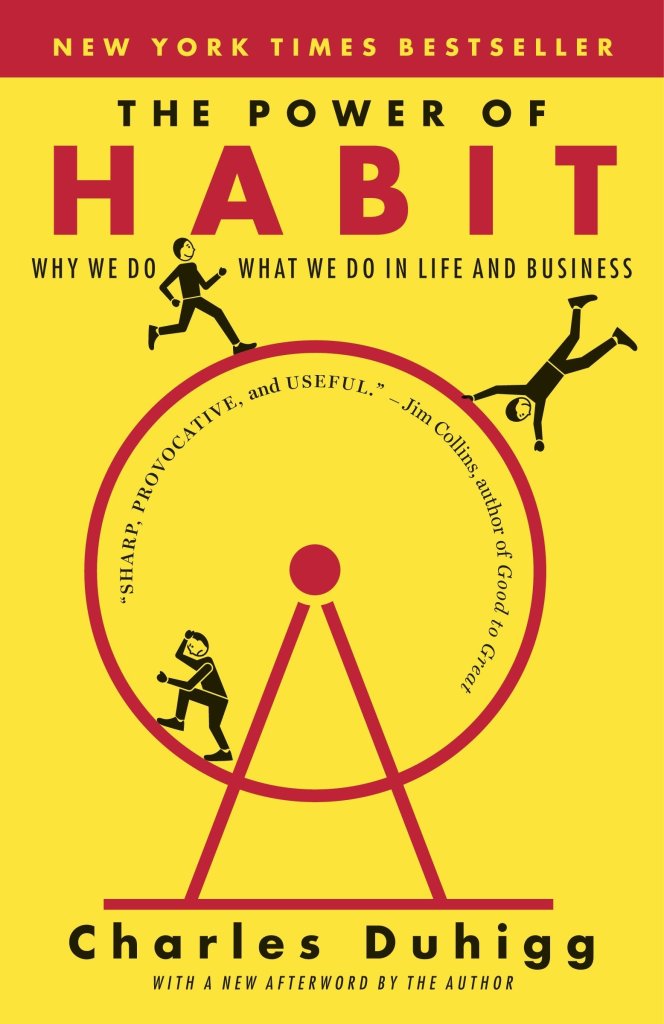
Although I may be aware of how my habits are being manipulated, for the sake of convenience, I become compliant and even explore how we can mirror these techniques in our sporting environments. But when one hears the realities shared in video documentaries, books, and academic research, one can’t help but become a little paranoid! So, today I am going to share some examples from Duhigg’s The Power of Habit to make you paranoid too!
Since I have heard this particular story from several resources, I will share about a current retailer and how they knew a teenager was pregnant before her father did. Duhigg shares how a retailer used data-mining in efforts to predict what items a guest will be interested in purchasing in the future and then market specific items to them. This eerie story demonstrates how our habits become predictors of future behavior. Using a pregnancy score based on data, this retailer would mail out coupons for baby items and one of the recipients happened to be a father who was angry that the store might be encouraging his teenage daughter to get pregnant. Guess what the store already knew that dad didn’t based on the purchasing habits connected to the teenager?
Moving away from sensitive issues such as predicting pregnancy, let’s examine the food industry. Duhigg’s cue and reward framework explains that “foods at some chains are specifically engineered to deliver immediate rewards—the fries, for instance, are designed to begin disintegrating the moment they hit your tongue, in order to deliver a hit of salt and grease as fast as possible, causing your pleasure centers to light up and your brain to lock in the pattern. All the better for tightening the habit loop.” Once these loops are created in our brains, we return in order to experience the rewards. Many other retailers utilize our habits in choosing specific locations-Walgreens on corner lots, Cinnabon distanced from food courts so “the smell of cinnamon rolls wafts down hallways and around corners uninterrupted, so that shoppers will start subconsciously craving a roll. By the time a consumer turns a corner and sees the Cinnabon store, that craving is a roaring monster inside his head.”
Duhigg sketches what he has dubbed “keystone habits which influence how people work, eat, play, live, spend, and communicate. Keystone habits start a process that, over time, transforms everything. Keystone habits say that success doesn’t depend on getting every single thing right, but instead relies on identifying a few key priorities and fashioning them into powerful levers. Understanding keystone habits holds the answer to that question: The habits that matter most are the ones that, when they start to shift, dislodge and remake other patterns. Keystone habits explain how Michael Phelps became an Olympic champion and why some college students outperform their peers.”
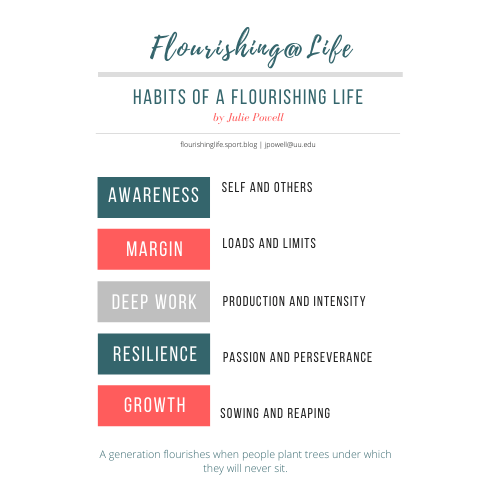
As you begin to mull over your personal habits in efforts to begin the process of examining how your good habits fit within the Five Habits of a Flourishing Life, how might you duplicate the techniques mentioned above and mine your own data about specific changes that might be beneficial to move towards a flourishing life?
 Flourishing @ Life
Using the Five Habits of a Flourishing Life could help transform college students into not only uber-productive members of society, but also young leaders on campuses and in the community. For my own life, being aware and “mining my own data” to help what determines my margin could help me create realistic goals for myself. Practicing deep work on a more consistent basis can help lead to more resiliency when it seems as though my passion for a project is waning. I can finally learn to reflect on ore personal growth, not only as a student, but as a believer and learn how to continually grow my personal drive and witness for Christ.
LikeLike
As one would after reading this article, I started to think about how companies and retailers would draw me into buying more and coming back to a certain place each time. While thinking about this, I started to get slightly freaked out by this because I know that their ads, programs, etc. worked on me and kept me coming back for more. Although this was a toxic or sneaky way of getting customers to come back you have to admit that it does work. As I started to brainstorm and think more about this topic I thought what if we could use the five habits of flourishing life to make a positive mark on our community and world. For example, I believe that there are so many ways and places that people could use a point system to encourage their customers in a positive way. Places like the gym would be perfect for this, it would encourage their customers to come back workout and get rewarded for doing something good. Another place that could encourage people to do well would be in the schooling system. This would teach students that school can be fun and they would be encouraged to come back and try hard each day. Overall, I feel that as a generation we can use the Five Habits of Flourishing Life paired with using data from people to make our world a more productive and encouraging place to live in.
LikeLike
After reading this article, I began thinking about how true the statements were regarding the ways stores keep their customers coming back for more. There has been many times that I have purchased certain things from stores and before I know it they have my email address or mailing address and I begin getting coupons and big sale dates that may be occurring in the future. Its a very sneaky but smart way because I almost always take advantage of the coupons and sales and end up buying more and more. The Cinnabon example stuck out to me also because that same example has happened to me before when I was shopping with my mom. I now understand why they place the Cinnabon carts in the locations that they do, it makes for a very efficient way to bring in customers and money. After thinking more and more about the examples, and thinking about the different ways we could use the 5 habits of flourishing life to make our lives, world and everyone else more encouraging. The one habit that stuck out to me the most was the growth aspect because not only could you use this mentally and physically but you could also use it spiritually. After reading this post, it makes my take a closer look into my life and my habits and try to place the habits of flourishing life in my everyday activities.
LikeLike
I find this very interesting. I think that I personally need to work on the habit of looking at the “margin” and knowing how much I can load myself down with. I often overload myself and then get stressed by everything that I have to do. This causes me to not be able to perform at the best of my abilities. I think if I work on this then I will be able to flourish more in life, and I won’t worry as much. I also think that by knowing my limits I will also be able to improve in the area of “deep work”. I will be able to increase my production rates because I will not be so weighed down.
LikeLike