
Having introduced Clear’s work, Atomic Habits in earlier postings, today we will investigate a little deeper his systematic approach to developing good habits and losing bad ones. Clear states, “an atomic habit refers to a tiny change, a marginal gain, a one percent improvement. They are little habits that are part of a larger system. Just as atoms are the building blocks of molecules, atomic habits are the building blocks of remarkable results. This is the meaning of the phrase atomic habits—a regular practice or routine that is not only small and easy to do, but also the source of incredible power.”
Providing us with an image of the layers of an onion (consider reading I Sliced Instead of Peeled), Clear communicates that there are three layers at which change can occur: (1) a change in your outcomes; (2) a change in your processes; and (3) a change in your identity. Level one is concerned with changing your results; level two is concerned with changing your habits and systems, so you implement a new routine; and level three is about changing your identity such as your beliefs and worldview. “Outcomes are about what you get. Processes are about what you do. Identity is about what you believe…Many people begin the process of changing their habits by focusing on what they want to achieve. This leads us to outcome-based habits. The alternative is to build identity-based habits. With this approach, we start by focusing on who we wish to become.”
Clear’s approach resonates with me as I am convinced that our faith not only shapes what we value but also determines our purpose. These outcomes become connected to our identity which influences our behavior and habits which ultimately impacts our attitude and perspective which defines either a flourishing or floundering life. If a person desires to instill in their regular activities the Five Habits of a Flourishing Life, they might best be served by utilizing Clear’s identity-based habits approach.
“Imagine two people resisting a cigarette. When offered a smoke, the first person says, ‘No thanks. I’m trying to quit.’ The second person declines by saying, ‘No thanks. I’m not a smoker.’ It’s a small difference, but this statement signals a shift in identity,” according to Clear. He continues, “There are a set of beliefs and assumptions that shape the system, an identity behind the habits. The ultimate form of intrinsic motivation is when a habit becomes part of your identity. It’s one thing to say I’m the type of person who wants this. It’s something very different to say I’m the type of person who is this. The more pride you have in a particular aspect of your identity, the more motivated you will be to maintain the habits associated with it.”
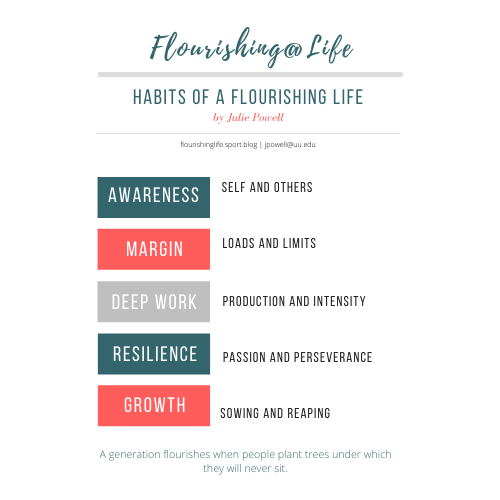
So, if one makes the decision to use Clear’s identity-based habits, a flourishing person would make statements such as, “I am a person of awareness as I know myself and pay attention to others. In my life, I create margin by knowing my load and setting limits. I am a person who strives to accomplish deep work. I am a person of resilience as I persevere in difficult times. I am a person who is intentional about personal, professional, and spiritual growth.” Rather than just setting goals and stating specific behaviors, the habits become connected to a person’s identity because “once your pride gets involved, you’ll fight tooth and nail to maintain your habits. True behavior change is identity change. You might start a habit because of motivation, but the only reason you’ll stick with one is that it becomes part of your identity.”
Developing the Five Habits of a Flourishing Life means “becoming the best version of yourself “which “requires you to continuously edit your beliefs, and to upgrade and expand your identity. More precisely, your habits are how you embody your identity. When you make your bed each day, you embody the identity of an organized person. When you write each day, you embody the identity of a creative person. When you train each day, you embody the identity of an athletic person.”
So, as we contemplate embracing these new habits, what identity statements might you make in efforts to reflect the identity of a flourishing person? Please take time to share your statements in the comments below.


I found this perspective of habit building to be incredibly helpful. I typically think of habits on a more “macro” level (ex. a habit of biting fingernails, or a habit of running daily), and not as tiny changes or improvements. To answer your question, here are some identity statements I believe reflect the identity of a flourishing person: “I am honest”, “I am committed”, “I am aware of my needs and the needs of those around me”, “I am aware of my strengths, and also my weaknesses”, and “I actively seek self-improvement”.
LikeLike
This analysis of habit building is incredibly insightful. It challenges the viewpoint that you have to accomplish the behavioral changes first and foremost before you can take pride in what you’ve done. Rather, it flips the order on its head by claiming that a purposeful change in identity will lead to pride in the new processes that will lead to desired outcomes. To answer the question posed, some statements a “flourishing” person might make are: “I care for others. I am a driven person. I complete the tasks I begin. I do not put others down to gain advantage. I strive to develop my spiritual growth everyday.”
LikeLike