
If you are unable to recall the 1987 public service announcement related to the dangers of drug abuse, our wonderful world of instantly accessible information allows you to click here to view the commercial. The scene depicts a man cracking open an egg into a frying pan to demonstrate the effects of using drugs. The advertisement by Partnership for a Drug-Free America has continued to utilize this analogy over the years, even as recently as 2018 with an attempt to emphasize the dangers of using cannabis. As a teenager during the Just Say No era, Nancy Reagan’s plea frequently played across the television screen and the slogan appeared on small signs designed to hang in the window of an automobile right alongside the one stating “Baby on Board.”
Entering a new decade in this century, the PSAs are not only encouraging responsible device use while driving but are even moving towards setting limits on screen time usage. These recommendations are vital to the development of emerging generations’ brains but should not be ignored by those of us with more years under our belts. As discussed in previous posts such as Is Gen Z a Canary? and Digital Minimalism, we are a culture facing unknown long-term consequences of device usage and what effects future adults will experience as a result of their screen time during developing years. As a professor who teaches courses that relate to one’s health such as drug education and nutrition, the issue of addiction is relevant whether it’s an illegal narcotic, food, or a smartphone.
If my desire is to help others develop Habits of Flourishing, where we recognize the need for boundaries and limits, it might be wise to explain the why behind moderation. In Leaders Eat Last, Sinek addresses the relationship between dopamine, a neurotransmitter related to rewards, and what occurs with our devices. “There is another thing to add to that list of things that can hijack our dopamine reward system: social media. Texting, e-mail, the number of likes we collect, the ding, the buzz or the flash of our phones that tells us ‘You’ve got mail,’ feels amazing. As it should. We have associated the dopamine-releasing feeling of ‘ooh, something for me’ with getting a text or e-mail or the like. Yes, it’s true, we hate all that e-mail, but we live for the ding, the buzz or the flash that tells us something’s there… It is said that if you wake up in the morning and the first thing you crave is a drink, you might be an alcoholic. If you wake up in the morning and the first thing you do is check your phone to read e-mail or scan through your social media before you even get out of bed, you might be an addict…in the case of our love of our devices and social media, we are less aware of the addictive qualities.”
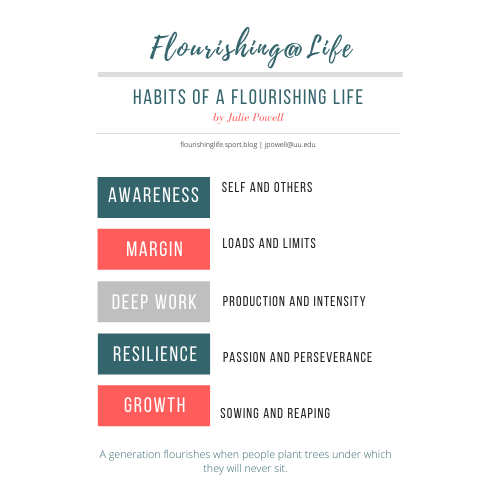
If our focus shifts to developing productive habits with regards to our devices, then it’s vital to comprehend that “Habits are a dopamine-driven feedback loop. Every behavior that is highly habit-forming—taking drugs, eating junk food, playing video games, browsing social media—is associated with higher levels of dopamine,” as Clear explains in Atomic Habits. Clear continues to outline strategic practices to assist with moving away from a bad habit and towards one of productivity; however, it is significant that we understand the seriousness of the issue we often joke about. The American Psychiatric Association (APA) in its Diagnostic and Statistical Manual (DSM) added in its fifth edition an expansion of the definition of addiction to also include behaviors, not just addiction to substances. This addition should speak loudly that professionals are treating an increasing number of issues related to our devices.
Encouraging all of us to evaluate our own ability to moderate our usage and not need the dopamine rush that floods our brain with every ding, buzz, or chirp, we might instead choose to increase our oxytocin levels, the chemical messenger responsible for allowing us to develop relational equity and bond with others. So, the next time you are with others, turn the phone on silent, engage face-to-face with those physically in your presence, and enjoy the oxytocin flowing through your brain.
Please feel free to share below effective strategies you are implementing to ensure that your device usage is a productive habit and not a behavioral addiction.
 Flourishing @ Life
Lately I have been extremely upset about my screen time. I absolutely hate when a notification pops up to tell me my average daily screen time for the week. I almost ruins my day. I decided today that I want to be on my phone less and watching TV less. This blog post has helped me to realize that I am actually addicted to my phone. It is the last thing I look at before I fall asleep and the first thing I wake up to. I have recently set screen time limits on certain apps that I get on frequently, and I feel like this has helped decrease my screen time just a little bit. I already feel the physical effects of staring at a screen most of the day. My eyes get red and itchy. I even had to order blue light glasses because they got so bad. This is definitely a wake up call for me to be on my phone a whole lot less.
-Sarah S.
LikeLike
This is a great post about limiting our time and usage of electronic devices. Being in my mid thirties I have seen a tremendous growth in personal electronic device usage in the last ten years. I’m personally not big into social media but just having a conversation with people with out their phone being a distraction is a hard thing to find now days. Until reading this blog I knew electronic devices where a distraction but I never realized it could be an actual addiction. One of the biggest differences in the last ten years that I’ve noticed is people interactions with each other out in public. At restaurants or even sporting events instead of interacting with each other they are on their phones. We have lost that personal interaction, myself included. Today we have 24/7 access into the news and other peoples lives through social media and other outlets. Since it was brought up in the blog about being addicted to the “ding” I have noticed feeling a certain way when I have a ding for a text. I think maybe part of that is feeling important and included. After reading this blog from time to time it would be important for me to take a break from any electronic devices. By doing this I could keep myself in check with the “real world”.
LikeLike
I really enjoyed this post! As someone that’s part of Gen-Z, I’ve noticed how obsessed we are with phones, social media, and technology. We have grown up constantly using it, so we don’t know how to live without it. However, one of my biggest pet peeves is when I’m in a social gathering and people are all on their phones instead of interacting with other people. I appreciated what the post said about “engaging face-to-face with those physically in your presence” by putting your phone on silent so you’re not distracted. Our addiction to smartphones is because we are craving approval, interaction, and attention; but it will constantly disappoint us. The Bible describes how we were created to desire and engage in community with others. When we silence our phones, we are able to fully engage with others and show that we care about them and want to be intentional with them. When we are distracted by our phones we are saying “there’s something more important going on than this conversation”. What is the message we want to communicate to others? Are we missing out on intentional conversations with others because of our obsession with our phones? Would we all be happier if we spent more time in community instead of on Instagram?
LikeLike
Pingback: Airplane Mode – Flourishing @ Life