
If one were to search the dictionary in an attempt to define the word poverty, similar words might appear such as scarcity, deficiency, shortage, or insufficiency. Most of the time when describing poverty, one’s mind has a tendency to ponder material assets such as money, property, or food; but today, I ask that you consider the current world we live in and offer that we are experiencing Time Poverty, a term brought to my attention while reading a thought-provoking view on life in higher education, The Slow Professor.

Would you be astonished to learn that according to a Gallup poll that in 2011, “70 percent of employed Americans reported that they never had enough time,” and that figure increased to 80 percent by 2018? How will that number rise in another seven years? The irony for me is that we currently live in the Digital Era where we have numerous devices which were designed to provide us with more time so that we could be more productive; and yet part of the issue surrounding Time Poverty is how much of our time these devices consume of our 24-hour day!
Giurge, Williams, and West define Time Poverty as “the chronic feeling of having too many things to do and not enough time to do them,” and it is this lack of a Habit of Margin with our time which is resulting in a disparity between economic growth and people’s happiness. These authors offer that these very devices provide “people with access to an infinite number of experiences and the opportunity to live a multiplicity of lives within a single lifetime. Thus, people increasingly worry about missing out, which can increase feelings of time poverty.” Emerging generations like Gen Z are especially vulnerable to this concept of FOMO (fear of missing out). Add in the shifting nature of work and this push to constant productivity, and rather than being viewed as restorative or nourishing, idle hours are viewed as unnecessary.
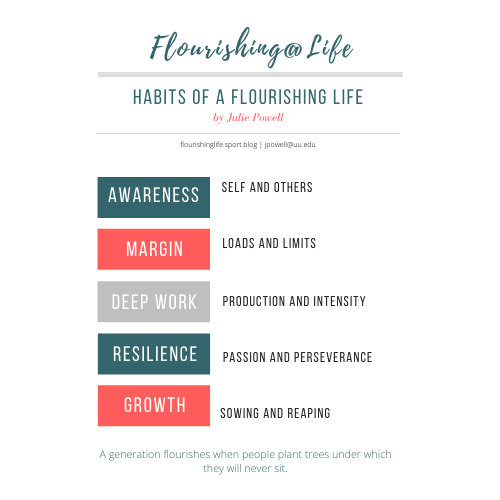
Addressing the “tension between the demands of everyday tasks and the conditions that encourage intellectual creativity,” Berg and Seeber propose that it is critical for us to support, at times in our lives, the embracing of the Slow Movement where we downshift from the accelerated speed of modern life into a more purposeful pace. This downshift allows for creativity to prosper in cultivating Deep Work, but also to experience the restorative healing that embracing a Sabbath, a period of idle time can provide. Time Poverty may be a significant issue in modern culture, but it must be addressed if we desire to have a flourishing life.
One aspect of daily living where Time Poverty is having a detrimental impact on a flourishing life is in the area of eating and physical activity. “Time is another resource people need to be healthy: Being active takes time as does provisioning and preparing nutritious food,” shares Venn and Strazdins. The ideas around the Slow Movement actually began as a response to culture’s hurried approach to eating (think McDonald’s in Italy, where meals are meant to be an experience), but reaches into many other aspects of our well-being. This feeling of scarcity, or poverty, spreads deeply into all areas of our health and impacts not only the current 24-hour period, but all the days we are granted life on this earth.
So, what strategies can we embrace that will diminish the impact of Time Poverty on our lives, whether that life exists inside the walls of higher education, the glass doors of the business world, or the property lines of our home? How can we make wise decisions which will slow down time so that we can engage in healthy dialogue, participate in physical activity, and savor the rich tastes of a nutritious meal?
References:
Berg, M. & Seeber, B.K. (2016). The slow professor: Challenging the culture of speed in the academy. University of Toronto Press, Scholarly Publishing Division.
Giurge, L.M., Whillans, A.V., & West, C. (2020). Why time poverty matters for individuals, organizations and nations. Nature Human Behavior.
Venn, D. & Strazdins, L. (2017). Your money or your time? How both types of scarcity matter to physical activity and healthy eating. Social Science & Medicine, (172) 98-106.
 Flourishing @ Life
The phrase “time poverty” caught my attention immediately; I have never heard it before but knew exactly what it meant. As a college kid, I feel like I’m getting pulled in different directions all the time. I find myself husting off the frisbee field to get to meetings and then rushing to the library after my meeting. There never seems to be enough time for normal activates, much less finding time to make a healthy meal. Making healthy meals often gets pushed further down the priority list, when reality nutritious meals are necessary to fuel us through our heavily packed days.
LikeLike
I had never heard the phrase time poverty before but immediately knew what it was referencing. As a college kid, I find myself being pulled in different directions constantly. I regularly have to hustle off the frisbee field in order to get to a meeting and then hurry out of that meeting to get to the library. I find that eating a nutritious meal slips further and further down my priority list when I should be doing quite the opposite. Eating well is what fuels my body to do all the things I’m pushing it to do. We should take the time to eat healthy in order to make it through our packed days without feeling burnt out.
LikeLike
Like Kayla said, I had never heard the term ‘Time Poverty’ before, but immediately knew what it meant. It is something I feel in my life quite often, particularly upon becoming a college student. Time is a precious resource in today’s world, and it feels like a million and one things seem to suck away at it.
One method I have found that enables me to feel like I have enough time for things is simply saying ‘no.’ It is hard, particularly with FOMO, but developing the skill of politely saying no has enabled me to fix my sleep schedule, ensure I have enough time for a couple hours of exercise per day, and succeed academically in all of my classes.
LikeLike
“Time Poverty” is a term felt to my core the second I read it, but until I read this post, I never realized how widespread it was. I always assumed it was just having too much on my plate. In reality, it is not slowing down enough to prioritize the things that need to be done. The thought of slowing down when I feel like I already am lacking enough time is something I never would have thought of myself. But it makes total sense.
I am a student at college, a daughter at home, and an employee at work which often leads me to feeling like I am spread a little too thin. As the post and Kayla state, I often neglect treating my body the way it should be treated, but then I expect it to both mentally and physically provide me with the means to get multiple things done at once. We cannot ignore the necessities and then prioritize non-essential things that feel essential.
LikeLike
“Time Poverty” is a term felt to my core the second I read it, but until I read this post, I never realized how widespread it was. I always assumed it was just having too much on my plate. In reality, it is not slowing down enough to prioritize the things that need to be done. The thought of slowing down when I feel like I already am lacking enough time is something I never would have thought of myself. But it makes total sense.
I am a student at college, a daughter at home, and an employee at work which often leads me to feeling like I am spread a little too thin. As the post and Kayla state, I often neglect treating my body the way it should be treated, but then I expect it to both mentally and physically provide me with the means to get multiple things done at once. I cannot ignore the necessities and then prioritize non-essential things that feel essential.
LikeLike
I have heard the saying “time poverty” before, but never really known what it meant. After reading this article I have a much better understanding about it, and I also feel I can relate to it. As a college student and an athlete, I sometimes feel I don’t have time to do everything I am supposed to do. With practices and homework, I often feel a need to do stuff that does not relate to that even though I do not have time for it.
I often take myself using my phone while I am doing homework. I think phones and other digital products can be “time thieves” for many people. The phone is laying beside me blinking with notifications and distracting me from fully focus on other things. This is the main reason why I often struggle to do my homework efficient and with quality. In my opinion, our phones and digital products could be one of the main reason why we are having the term: “time poverty”.
LikeLike