
In the research to discover some of the best strategies for assisting emerging generations in their pursuit of a flourishing life, I’m frequently astounded by how often the concepts seem so simple on the surface, a bit of common sense even; however, when it comes to pursuing these practices that develop the Habits of a Flourishing life, the behaviors move from common sense to complicated challenges. As an educator, or anyone with influence over others, we are distinctly aware of some of the desired outcomes we hope to instill: to be collaborators rather than consumers, participants rather than observers, and givers rather than takers.

It is this last mindset shift of understanding the difference between Givers and Takers that is the focus of today’s post and is explained by Adam Grant in his book Give and Take: A Revolutionary Approach to Success. Grant shares, “Giving, taking, and matching are three fundamental styles of social interaction,” or what he calls reciprocity styles, which explain how most of us approach people the majority of the time. According to Grant, our primary style “can play as much a role in our success as hard work, talent, and luck.”
To further explain this concept of Givers and Takers, Grant offers to introduce us “to two kinds of people who fall at opposite ends of the reciprocity spectrum at work. I call them takers and givers. Takers have a distinctive signature: they like to get more than they give. They tilt reciprocity in their own favor, putting their own interests ahead of other’s needs…Garden-variety takers aren’t cruel or cutthroat; they’re just cautious and self-protective.” Givers, on the other hand, “tilt reciprocity in the other direction, preferring to give more than they get. Whereas takers tend to be self-focused, evaluating what other people can offer them, givers are others-focused, paying more attention to what other people need from them.”
What is interesting to me in discussing reciprocity styles, is that there are applications to personal, professional, and spiritual development. It is not as uncommon to see the benefits of giving rather than taking in personal relationships such as those with family members, but Grant offers insight into how the professional life can flourish when we adopt a giving reciprocity style, and I will take this concept even further and offer that we are to model a giving reciprocity style in our spiritual life as well. After all, isn’t that what Christ modeled for us while he was leading others during his transformissional journey on this earth?
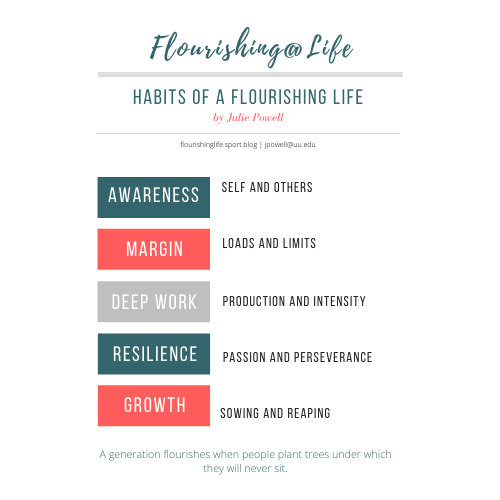
What I see Grant describing as utilizing a giving reciprocity style at work to become successful also has applications when one is attempting to develop a Habit of Awareness of both self and others. Grant shares, “Being otherish means being willing to give more than you receive, but still keeping your own interests in sight, using them as a guide for choosing when, where, how, and to whom you give. Instead of seeing self-interest and other-interest as competing, the Caring Canadians found ways to integrate them, so that they could do well by doing good. As you’ll see, givers are less prone to burning out and getting burned-and they’re better position to flourish.”
Grant shares stories from social science research of the benefits of volunteering and from neuroscience on what happens to the release of chemicals in our brains when we engage in giving and pursuing activities that focus on the needs of others rather than our own. When we look at givers from a health perspective, we also see numerous benefits to our mood. “Economists call it the warm glow of giving, and psychologists call it the helper’s high.” Regardless of the discipline lens one uses to examine Givers and Takers, the evidence mounts highly in favor of the giving reciprocity style. Add in the wisdom from Scripture and the scale tips even further into the relationship between a giving reciprocity style and a flourishing life.
A third reciprocity style Grant describes is that of a matcher. “Professionally, few of us act purely like givers or takers, adopting a third style instead. We become matchers, striving to preserve an equal balance of giving and getting. Matchers operate on the principle of fairness: when they help others, they protect themselves by seeking reciprocity. If you’re a matcher, you believe in tit for tat, and your relationships are governed by even exchanges of favors.”
To wrap up this discussion of Givers and Takers, I am challenged to uncover how to help emerging generations discover their reciprocity style and how the knowledge of this information can be deeply explored to gain insight into how embracing a giving style will lead to flourishing in the areas of personal, professional, and spiritual growth. I am also challenged to explore my own personal reciprocity style to determine how I can move from being a taker or matcher and into being a giver. Please feel free to share in the comments below your thoughts on Givers and Takers.
Reference:
Grant, A. (2013). Give and take: A revolutionary approach to success. Penguin Group.
 Flourishing @ Life
Pingback: Agendaless Conversations – Flourishing @ Life
I have never thought about the different styles of reciprocity and how it could so important to know about yourself. After reading this post I definitely resonate with the matcher. I can see myself in both the giver and taker category. I think one’s style of reciprocity really just depends on the situation. I after reading the definitions of a giver, taker, and matcher I can give many different scenarios in my life where I have been one of these styles. I think that this topic is something that goes unnoticed and not talked about. In my opinion, I think everyone should strive to be a giver which would cease of takers and matchers.
LikeLike
This blog was very interesting to me because it put things into a perspective for me. In this we learn about reciprocity and the many different styles that come along with it. There is giver, taker, and matcher. I knew about giver and taker but I was not as familiar with matcher. It mentions in the reading that if we decide on a reciprocity then we will flourish more in life. I want to flourish in life too so now I am asking myself which one is most likely like me. In many situations I have been all three but at this point in my life I am definitely a giver more than anything else. No one wants to be a taker so everyone should shoot to be a giver because it will take you farther in life.
LikeLike
This blog was very interesting to me. I always heard the words givers and takers but I never actually knew what they were. Now that I think about it there as been many situations where I have been a giver, taker, and a matcher. The one I was not very familiar with was the matcher but once I read the meaning then I realized I have been a matcher before. Reading that choosing a reciprocity will help you flourish in life really put things into perspective for me because I never thought about it in a way like that. I am more of a giver at this point in my life which helps me a lot in situations rather than a taker and matcher would do for me. People should look to transform to a giver because you will be rewarded a lot more in life as a giver.
LikeLike
I enjoyed reading this blog post and it really made me think. I never really just thought about reciprocity styles. I have heard of being a giver and a taker, but I have not heard the use of being a matcher. I read this blog trying to figure out what I am exactly. I do believe that I am a giver for the most part, but I also understand being a matcher. I believe that how you treat others and what you do for others is what determines how you will be treated. When I am giving, I am not automatically expecting something in return, but I do believe something will come in return eventually. I believe being a taker is a selfish act, and I believe we should try our best to avoid being a taker. I really enjoyed this vlog and how it helped me to think about who I am.
LikeLike
I really enjoyed reading this blog. It opened my eyes for sure. I think that a lot of takers tend to not really know or realize that they are doing so much of it until someone decides to tell them. I think givers are a special kind of breed especially in today’s society. A lot of givers put others before themselves and make sure others have what they need then they attend to themselves and what they need. Being a taker is very selfish and it can come back to bite that person later in life. Givers may not see the reward now but in the end what they do for other people is what is right and make what they have done in life seem so great.
LikeLike
Pingback: Fillers and Dippers – Flourishing @ Life
Pingback: Taking Turns – Flourishing @ Life
This blog post gave me a lot to think about having never really heard or talked about think the concept of givers and takers. For over five years now, I have been working in childcare and trying to do my part to give the kids the tools they will need as they grow up. I think it’s hard not to be a taker though in everyday life. For me, it is a conscious decision to be a giver whereas most people are programmed to be a taker. I think it’s because it is a lot easier to be a taker, being a giver requires more energy and thought. With that being said, I have seen in my own life that when I do good for others and live more as a giver, I can see my life flourish.
LikeLike
Pingback: Belly Button – Flourishing @ Life
Pingback: Meet in the Middle – Flourishing @ Life
Pingback: Siri in the Sky – Flourishing @ Life