
One of the common threads consistently emerging in my reading, probably due to the fact that it’s a skill that I have yet to master, is this idea of embracing a Listening Life, specifically what Gibson and Beitler describe as Humble Listening, and its relationship to the ideas I mentioned in the post Writing Well. Now, to be perfectly transparent, before reading Charitable Writing, I would not have made a connection between Humble Listening and any communication I might compose; however, the imagery painted for me in this book, has me carefully considering its ideas, even as I type this simple blog post.
“Humble Listening, as we’re defining it, involves paying careful attention to our neighbors and their ideas; such attention is born out of our love for them and for learning itself as well as an acknowledgement of our fallenness and finitude.” To provide a visual picture of Humble Listening, the authors use a quote from American poet Alice Duer Miller, “You can listen like a blank wall or like a splendid auditorium where every sound comes back fuller and richer.” What a captivating description of how I am challenged to reconsider the intricate dance between listening and writing, and an approach I would hope my students might embrace when considering how well they listen to their neighbors, whether it’s peers in their classroom or a professor’s feedback on an assignment.
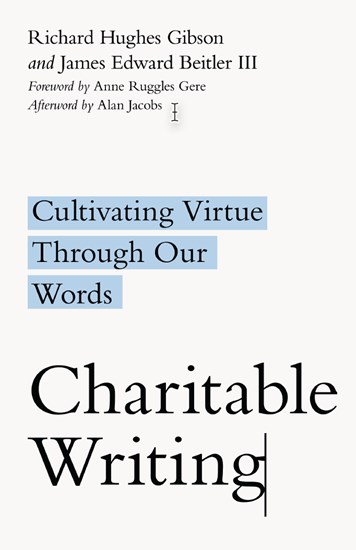
“While listening is sometimes associated with pious silence, Humble Listening is like Miller’s auditorium. It doesn’t just take another’s words in; it offers them back ‘fuller and richer.’ Humble Listening receives in order to respond, and responds in order to receive still more. It is an art of enrichment.” Gibson and Beitler expand even further on this idea when focusing on the college environment. “…we’ve never heard a student express the hope that the skills developed in the class will support anyone else at all. The reason for this self-focus is not difficult to discern. Most of us are trained from an early age to think about our educations in individualist (and often consumerist) terms. The idea that our educations should serve the common good is one to which most of us would give ready assent, but we imagine that payoff taking place somewhere down the line-usually after our schooling has ended…we view fellow participants [in class] not as competitors but as peers, people from whom we can learn and with whom we will collaborate in the process of developing our work.”
Although a part of me hesitates to use so many quotes in one blog post, I certainly appreciate that engaging in Writing Well and Humble Listening involves acknowledging that an expert’s words are often preferred because they are the most concise and precise form of communicating an idea. So, I’ll choose to use their expressions because they are easily applied to most relationships in which we engage. “…your fellow participants are not simply peers but your neighbors. To recognize them as such brings with it an obligation, for, as our Lord teaches, we must love our neighbors…Giving your classmates your full attention is a means of practicing Charitable Writing. They will benefit greatly from such attention-as will you.”
And the authors continue to illustrate for me what I imagine as an engaging classroom, or a Hospitality Room. “…you are simply not listening well if you don’t talk back…At the very least, they need to know that they have been properly understood, and they often need to receive your comments and criticisms so that they can improve their ideas and arguments…Where Humble Listening flourishes, participation is liberated from the exhausting routines of one-upmanship. You no longer need to worry about speaking a certain number of times per session, getting your two cents in, or saying your piece. The mantra of humble listening is, it’s not all about you. Rather, participation becomes more about ‘taking part in,’ and hopefully building up, community.”
What a challenge to embrace investing in the skill of Humble Listening in all areas of my life, from the classroom to the living room! What a beautiful picture is crafted for us when we consider how Scripture instructs us to communicate from the heart. “Viewing class participation as an opportunity to pass the peace of Christ liberates us from the struggle to puff ourselves up at the expense of others (Mt 23:12). We are free to build up our classmates in love, using our words not as swords for cutting others down but as plowshares for creating fertile spaces where they can [flourish]…When we agree with what our classmates have said, we can say so and-even better-validate their ideas by affirming and extending them. When we disagree, we can express our convictions with sensitivity, mindful of Paul’s exhortation to be ‘tenderhearted’ to one another (Eph 4:32). And when we do hurt each other, as inevitably happens when we live and work in community, we will be more willing to apologize and, perhaps, even quicker to show mercy.”
My dreams to acquire a posture of Humble Listening might be far out of reach, but I will continue to strive to achieve it and do my best to create spaces in higher education where this form of listening occurs. Help me accomplish this by sharing in the comments below examples of when you have experienced Humble Listening.
Reference:
 Flourishing @ Life
HI!!
I hope Alaska was all you thought it would be and MORE~. I drove there with a friend and was amazed by all of Godâs glory!!!!
Do you have a library instead of TV?? I notice you write about readings- Iâd like to chomp with you- how often do you read? How do you decide what to read? When do you write? How long does it take for you to write? Thank you so much for your work! You are an inspiration to me!!!
Are you going to CSKLS?
Blessings my friend!
Cathy Headley, Ph.D.
Associate Professor
Rockford University
Department of Kinesiology
5050 E. State Street
Rockford, Il 61008
LikeLike
. This article was very eye-opening for me and it was very relatable and I appreciated the vulnerability of the author on the idea of listening. Truly listening. And not just because you feel that it’s the right thing to do, but because you genuinely care for someone and what they have to say. Often times we are caught up in the motions of life, and so we don’t give ear to those around us, but intentional, patient, disciplined listening is a skill, a virtue, that should be developed at some point in one’s life. It’s a gift that we develop and are then able to give to others.
LikeLike
Pingback: Holding Space – Flourishing @ Life
Pingback: Meh – Flourishing @ Life