
Expressions we speak in the South are baffling to many Americans, I cannot imagine the struggle that comes in translating idioms such as “Were you raised in a barn?” into another language. Today, I will not pose this question to you, but should you visit my home and happen to leave the door open, I am likely to inquire, “Were you raised in a barn?” But today, I am asking you to consider another use of these words and a unique metaphor for engaging in a conversation, Barn Raising.
Having never participated in a Barn Raising myself, I’m uncertain why this imagery tickled my brain as I pondered both personal and classroom conversations, yet as I immersed myself in Gibson and Beitler’s Charitable Writing, I found myself intrigued by their perspective on the concept of argument. “The formula [for an argument] runs like this: an argument seeks to persuade an audience to adopt a position…using solid evidence and sound reasoning.” This perfectly describes my expectations when engaging in classroom dialogue or with friends and family. Often, my attempt to “argue” is seen as critical and combative rather than an intellectual exchange. Gibson and Beitler share Alan Jacobs’ assessment that in our current culture, argument is viewed as war. “’When we accept this problematic approach to argument or debate, people cease to be people because they are, to us, merely representatives or mouthpieces of positions we want to eradicate, then we, in our zeal to win, have sacrificed empathy: we have declined the opportunity to understand other people’s desires, principles, dreams. And that is a great price to pay for supposed ‘victory’ in debate.’”
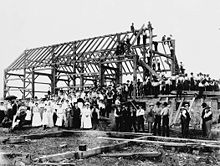
Rather than accept this idea that to be engaged in debate is war, what if we replaced that notion with viewing argument more akin to a Barn Raising? Instead of failing to see others “as creatures formed, like us, in the image of God,” we call a ceasefire, and embrace Don McCormick and Michael Kahn’s Barn Raising metaphor which acknowledges “human limitation” and recognizes that the “final product is stronger thanks to mental and manual efforts of other contributors.” When we view a conversation/argument/debate in this light, we build on what others are sharing rather than viewing it as a contest. “McCormick and Kahn urge us to think about academic argument-as a communal activity in which ideas are shared. When argument is understood as barn raising, they observe, your ownership of your ideas is productively undermined…ideas become communal goods rather than individual possessions…arguments are to be experienced as construction sites rather than battlefields.”
For me, higher education has been a Barn Raising, where ideas are exchanged, it’s acceptable to disagree, and we use the differences as a springboard for further conversation, not war, but genuine empathetic dialogue. In my mind, Flourishing Organizations, use the Barn Raising concept in a variety of settings including departmental meetings, administrative gatherings, town hall meetings, and within individual conversations. Persuading me that this Barn Raising approach might also be effective in classroom discussions, McCormick and Kahn describe “students, building on colleagues’ ideas, maximize the chances of freeing their own flexibility and creativity.” And as Parker Palmer offers in Courage to Teach, in good discussions and conversations, everyone is learning, even the facilitator. “Investigating student thinking can bring surprising insights.”
So, I ask readers to share in the comments below about a time when you participated in a Barn Raising conversation. What did you learn about Humble Listening to the other perspectives in the room? How can Barn Raising conversations allow us to engage in community with others in a way that fulfills Jesus’ commandment that we love our neighbor?
References:
Gibson, R.H. & Beitler III, J.E. (2020). Charitable writing: Cultivating virtue through our words. IVP Books.
McCormick, D. & Kahn, M. (1982). Barn raising: Collaborative group process in seminars. The Organizational Behavior Teaching Journal, 7(4), 16-20.
Palmer, P. (2007). The courage to teach: Exploring the inner landscape of a teacher’s life. Jossey-Bass.
 Flourishing @ Life
Pingback: You’re Invited! – Flourishing @ Life
Pingback: Asking Over Assuming – Flourishing @ Life
Barn raising is an interesting concept that I never heard of before this article. Barn raising does have some important aspects to it that I think can be applied to other things in society and in hospitality. There have been many times in my life where I have taken part in barn raising. I have many friends and classmates who have differing opinions and beliefs compared to me. Most of the time I just sit and listen whenever politics or religion comes up. I like hearing the other side because I feel like it makes me a more empathetic and compassionate person to try to understand where the other person is coming from. I also love my friends, and I know that they are good people, and I do not want to let their political and religious beliefs cause them to become a “bad person” in my mind. This is important because I have seen a lot of friendships and relationships end because of differing opinions. I do not want any of my friendships to end or have any hostility with anyone over a difference of opinion. To me it does not matter what you believe if you respect everyone and are not causing any harm to anyone or anything.
Another important thing to add is that while I do listen to everyone else’s opinion, I feel like I have less of a voice to say what I believe. Even though I know all my friends’ opinions and beliefs, I feel like they do not know any of mine. I have never talked to my friends about these subjects because I fear losing them as friends because of the differences in our opinions. For example, one of my friends that I have been best friends with for years does not know a whole part of my opinions or beliefs. To me it does not matter if she knows or not because I care too much about our friendship to let something as silly as politics and beliefs get in the way of our friendship. But at the same time part of me wishes that others had the barn raising skills to not let other opinions get in the way of a friendship.
I believe that barn raising is an important skill to have because it leads to others being more compassionate, more thoughtful and accepting community. This is something that a lot of society lacks. I think that this is important to bring kindness and community back into our world. Barn raising fulfills Jesus’s commandment of “Love thy neighbor” because to love our neighbor we must be understanding and accepting of them. If we hold hostility to each other, it does no one any good. It divides us up even more. I hope that as a society and a community we can have more barn raising conversations and hopefully heal the divide that is plaguing our society.
LikeLike
I believe Barn Raising is a great way to foster discussion within the classroom because of the fact that you need others to challenge our own ideas and make us use critical thinking skills to determine our opinions. Barn Raising also allows for others to respect different opinions and make sure people know how to respond to these opinions and gives them something to base their responses on. We need others’ opinions to determine what we think is right or wrong in all aspects of life but the kicker is we have to be respectful and accepting of all people’s opinions because this goes along with the biblical principle of loving your neighbor. in order to have good dialogue I agree that you can’t turn it into a war. there has to be a mutual understanding that everyone has different thoughts and opinions and everyone won’t agree on them. some of the best discussions I’ve had in class have been with people I don’t all the way agree with because we had a mutual understanding that disagreement was part of the discussion and that’s how we learn and grow as scholars.
LikeLike
After the class discussion about cultivating hospitality, the idea of hospitality as a way of engaging others in conversation stood out to me, especially when I read the post on Barn Raising as a metaphor for argument and conversation. Instead of viewing arguments as something to “win,” the Barn Raising metaphor shows conversation as an activity where everyone contributes something useful. This technique is tied to hospitality since it needs openness, humility, and a willingness to actually listen rather than just answer.
What impressed me the most was the idea that an argument does not have to be aggressive to be productive. Gibson and Beitler demonstrate that modern culture often considers argument as a war, with empathy traded in the goal of victory. Alan Jacobs perfectly expresses this when he states, “When we accept this problematic approach to argument or debate, people cease to be people because they are, to us, merely representatives or mouthpieces of positions we want to eradicate” (Jacobs, as cited in Gibson & Beitler). This quote made me think about how often I mistakenly shut out other people’s viewpoints because I’m too focused on defending my own ideas rather than showing hospitality by listening.
In my personal experience, I’ve seen how Barn Raising conversations can promote hospitality, especially during classroom discussions and group projects. When students collaborate rather than compete, the environment becomes more inclusive and productive. This is consistent with McCormick and Kahn’s argument that ideas should be viewed as communal goods rather than private belongings. Applying this mentality has helped me become more patient and open to disagreement, allowing conversations to grow rather than fall apart. Finally, embracing hospitality through Barn Raising discussion reflects the invitation to love our neighbors by valuing their perspectives and acknowledging that growth happens together rather than alone.
LikeLike