
by Dr. Kelvin Moore, Union University, from 2021 Fall Faculty Workshop
My wife and I live on a road. We don’t live on a street or in a subdivision. Five additional houses, four of whom were family, exist on this approximately mile and one-half road. The road is country and county, we don’t live inside any city limit. I leave our driveway, turn west and walk a loop. On this loop, about a half-mile from our house, for the first-time, I met one of our neighbors. This neighbor didn’t like me and communicated that clearly. In fact, the first time I met him, I thought he and I were going to come to blows.
I estimate our neighbor weighed somewhere around seventy-five pounds. Not big for a human but rather large for a dog. I didn’t recognize his breed. He had a jet-black coat, with a beautiful half-black, half-white face. His feet were also white. The big dog, barking and growling, rushed to meet me, hackles raised. Sometimes he circled me a few times. As he approached, I simply showed him the hickory stick I carry every time I walk. I never hit him, never swung at him but I wanted him to know I was “locked and loaded.” This song-and-dance went on for years as we developed an understanding: “if you won’t try to bite me, I won’t try to hit you with my stick.”
In time, both of the big dog’s humans passed away. I assumed, correctly at first, I would not be seeing any more of him. And, suddenly, he was back, growling and barking in his menacing tone. He stayed for a few days and was gone again, only to return again in a few days.
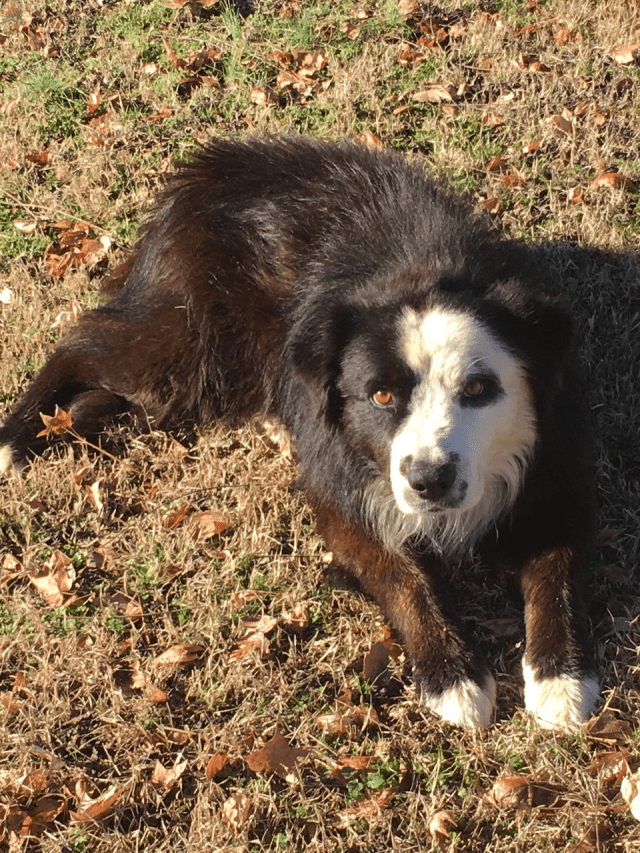
I felt compassion for the dog. It wasn’t his fault his humans passed. Nor did he understand what happened to them. He seemed sad to me. As I started out for my daily walk one day, I reached into our pantry and took out bread. As I passed his house I broke the bread into small pieces and placed it on the driveway. I walked far enough away to make the dog comfortable, and he found my offering. I discovered that he loved bread. I began tossing bread up the driveway where he inched to and ate it. I graduated to tossing it into the air where he would circle underneath and catch it in his mouth. Not knowing the dog’s name I called him Benji.
As I fed Benji one-day an automobile entered the driveway. A man and woman emerged. The woman recognized me, calling me by name. She then identified herself as a granddaughter of the now-deceased couple. She introduced her husband. I told them I had been feeding the dog for some time and I hoped they didn’t mind. They kindly expressed their appreciation for my care and said they certainly didn’t mind me feeding him. The man explained, after the passing of his wife’s grandparents, they had taken the dog home with them. The animal stayed a few days, but he had returned to his former home, traveling a few miles and crossing one major highway. After a few attempts, they decided to allow him to live out his days on the property. Someone checked on him daily, keeping food and water available. The man smiled as he heard me call the big dog Benji. “His name is Charlie,” he informed me.
Over time and using the bread as bait, I began “reeling” Charlie in, closer to closer to me. Deliberately, I tossed bread closer and closer, forcing the dog closer. In what I guess to be two years, Charlie, AKA “Benji,” finally allowed me to touch him.
The large animal reminds me of two important Life Lessons.
#1. Some of the most challenging relationships are also some of the most meaningful. Getting to “know” Charlie was a challenge, but also rewarding. My experience as a college educator, now in my thirty-first year, has taught me students can be divided into three groups. One group wants to know me. Eagerly, energetically and enthusiastically they introduce themselves before/after class, in a hallway or on a sidewalk, in the library or seek me out in my office. A second group makes no effort to know me. For whatever reason, they demonstrate no desire to know me. Perhaps they are shy or intimidated. Perhaps they are simply disinterested or maybe they don’t/can’t resonate with me. But there is a third group. This group is like Charlie. This is the group that a relationship is potential but takes effort. It may mean I initiate conversation, asking them to stop by the office and introduce themselves or invite them for a meal. In my office or over a meal we often talk about families, college major, college minor, ambition, motivation, favorite books. I reminiscence, across the years, some of the most challenging students to get to know personally have also been some of the most rewarding.
#2. Charlie reminded me that we should find pleasure, happiness, meaning and purpose in some of life’s “smallest” pleasures. With my imagination, I think Charlie smiled at me. He often bounded up to me as I imagined him thinking: “you got something for me! I know you do!” The author of Ecclesiastes reminds us: “So I commend the enjoyment of life, because there is nothing better for a person under the sun than to eat and drink and be glad” (8:15). We are told to find pleasure and happiness in “eat and drink.” Unless one is fasting, eating and drinking is something we do every day, often without thought. These are small, ordinary, even common, occurrences but we should find happiness and pleasure within them. COVID-19 restrictions have taken and continue to take so much from us. Perhaps there has never been a time in our lives when the recognition of life’s “small” blessings has been so significant.
I truly enjoyed getting to know Charlie. This unexpected, surprising and unlikely relationship gave me much pleasure. I hope Charlie felt the same way.


Thanks for sharing!
LikeLike
Pingback: Enjoy the Process – Flourishing @ Life