
Perhaps, like me, when you see the term Emotional Adolescent, your mind conjures up memories of your own teenage years and how much turmoil seemed to exist on an hour-by-hour basis. In a small space of time, life goes from being abundant and flourishing to something more akin to Raging Seas. I’m grateful that my memories of those days, for the most part, are relegated to the past, and that with age and maturity, most of life’s experiences fail to register as high on the emotional scale as events did back in the 80s. However, my reason for mentioning the phrase Emotional Adolescent today is in a different context than the angst of navigating our teenage years.
Frequently appearing in my reading these days is the concept known as emotional intelligence, which I introduced in the post entitled IQ, EQ, and HQ. So, like any good Emotional Detective, I chose to investigate this idea deeper and to complete an assessment to gauge where I ranked on the emotional maturity scale from Pete Scazzero. And as one should with any assessment tool, I will test for reliability at a later time, but the current results describe me as an Emotional Adolescent. Rather unpleased by these results, I admit to placing the information aside and moving onto other topics that are a little easier to digest. However, as the Lord often does in my life, He will continue to repeat a message until I relent and say, “Speak Lord, I’m Listening!”
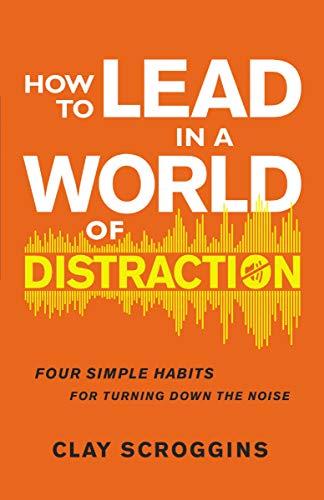
Now, Scazzero’s description of an Emotional Adolescent arises from the perspective of discipling others, with the hopes that one will take strides to moving along the continuum from infancy to adulthood, but understanding where our starting line is becomes essential to navigating our way to the finish line, which is hopefully emotional adulthood. What I am discovering, and the idea Clay Scroggins articulates so well in How to Lead in a World of Distraction, is that this concept of emotional intelligence is a part of developing a Habit of Awareness for a Flourishing Life. Scroggins shares, “…self-awareness is sometimes referred to as emotional intelligence. As you grow more intelligent about your own emotions, you will be better able to help others understand their own emotions. But it all begins with you. Too often we allow our emotions to sit in the driver’s seat, taking up that leadership space without any interrogation or confrontation.”
Sharing personal experiences from his own life, Scroggins suggests that we become Emotional Detectives in order to develop the Habit of Awareness because it’s so easy to allow our attention to wander and to be focused on distractions that prevent us from a deep, or flourishing life. “A life of distractions is a shallow life, a live lived without self-awareness. It’s a life lived in constant anticipation of the next thing that will keep you from slowing down to listen to what’s happening within.”
Slowly, I’m learning to absorb wise advice when given such as from Scroggins when he challenges: “You’re the only one who can honestly judge your distractions, look at what they’re costing you, and then do something about them.” Currently, I am in a season where the Lord is asking me to Take It Slow, to not allow distractions to speak so loudly that I am missing out on where my feet are (more on that topic later). Today, this means that although my Racing to Roam goal has now been achieved after 14 years, I should consider savoring the moment and not move right into what’s next. To enjoy reflecting on the people I’ve met, the places I’ve traveled, and the enjoyment that came with those adventures.
Although I may currently be an Emotional Adolescent, the desire is to move onto adulthood, but a necessary part of that process is looking within, gauging where I am and where I hope to be. It would be too easy to stay a teenager forever, but God is calling me to maturity and in order to lead those within my sphere of influence, I might need to accept the challenge to grow up a little in my emotional intelligence; and that’s often difficult to admit.
Who in your life would you describe as an emotionally mature adult? Who do you see handling their emotions and life circumstances well? Please feel free to share in the comments below.
References:
 Flourishing @ Life
Dr. Powell, as a psychology major, I appreciate you researching this topic. Scazzero’s explanation of emotional adolescents was impactful to read. Clay Scroggins’ idea that emotional intelligence involves forming a habit of awareness for a flourishing life reminded me of a discussion I had in my social psychology course. IQ may get you hired, but EQ is what will help you climb the ladder of life success. We need to be able to emotionally understand the world around us and the world inside of us. This blog post allowed me to have a renewed reminder that I need to continue to be self-aware to better interact with myself and my environment. I see how my grandmother has displayed the characteristics of an emotionally mature adult. She has given me great advice on how to eat cleaner foods and use environmentally safer products. She also gives wonderful relational encouragement and has a great deal of self-awareness when it comes to dealing with relationships in a God-fulfilling way.
LikeLike
Dr. Powell, I found this journey of yours into discovering emotional intelligence intriguing. I feel that, as a society, we are becoming less self aware and more driven by emotion than ever before. True emotional intelligence is a hard thing to come by, and I believe that an honest pursuit of productive self awareness and implementation is an extremely worthwhile venture. Increasing emotional intelligence can allow for one to learn how to interact with one’s own emotions and ideas, in turn allowing one to process and utilize one’s emotions correctly and in turn communicate effectively with the outside world. I appreciate your research on this topic and how you have attempted to test it in your own life. I also appreciate the resources that you have provided.
LikeLike
Pingback: Holding Space – Flourishing @ Life