
Sitting in a theater in Jackson, Tennessee, back in a past millennia, I encountered a very rare experience—the feeling of “I didn’t see that coming!” at the conclusion of a film. Other than an elusive thought that one of the main characters was still wearing the same shirt, the ending escaped my typical plot-uncovering skills. If you have never seen the intriguing movie entitled The Sixth Sense, I refuse to ruin that experience for you here, but am going to refer to a quote from one of the main characters, Cole Sear, who says the line, “I see Dead People.”
The quote from this movie is a rather famous line and one that often comes to mind when I hear or see the two words placed together. During the question-and-answer session of a presentation on a mentoring model at the 2nd Global Congress on Sport and Christianity in 2019 at Calvin College, my colleague Dr. Laci McRee and I were presented with the question from an attendee, “Does your model include Dead People?” Once the question penetrated my brain past thinking of the quote from the movie, I excitedly answered, “Yes! We do include Dead People!” In fact, it was an area of the model that I had anticipated some push-back on—the fact that in my opinion, Dead People can serve as valuable mentors, not only to Emerging Adults, but in any Season of a Professional’s life.
Following up the attendee’s question with an inquiry of my own, the desire was for him to expand a little further to be sure that our thinking was on the same page. “What do you mean by Dead People?” Receiving the answer I anticipated, he shared that in his personal, professional, and spiritual life, he found C.S. Lewis to be an instrumental mentor although he had obviously never personally had a conversation with the British writer and theologian. His question and subsequent answer validated the reasoning for including the domain entitled Resources within the model. We appeal to users of the model to not only think of living beings as great mentors, but to consider Scripture, authors, historical figures, and members of previous generations, often Dead People, as instrumental and transformational guides to navigating the journey to a flourishing life.
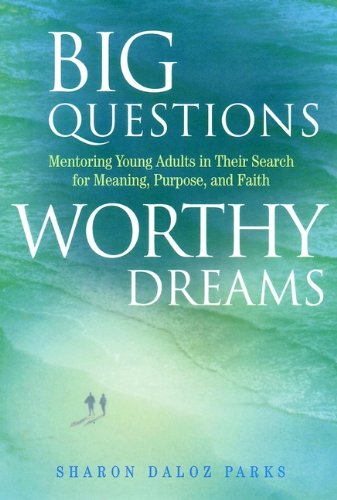
During my reading this week of Sharon Daloz Parks’ Biq Questions, Worthy Dreams, I was reminded of this relevant conversation from the Congress when she discusses the importance of belonging in our developmental process into adulthood and beyond. Not only does Parks address the issue of Dead People, but she touches on numerous concepts that I have found to be essential on this journey to a flourishing life including the importance of Relational Equity.
Parks shares, “Networks of belonging take various forms. Some are manifest as an obviously present and easy-to-identify circle of face-to-face relationships confirming identity and security: families, neighborhoods, workplaces, athletic teams, religious communities, or the regulars at the local cafe. But they may also be scattered geographically or otherwise dispersed. Increasingly, many find their tribe [Who’s in Your Posse?] linked by digital technologies—with only occasional direct encounters—a network of belonging stretched thin in which ironically one may feel at once both extensively connected and very much alone. Even those who choose a life of total solitude still and necessarily embody a self formed by a history of relationships with those who count, both living and dead. One could, for instance, have a strong sense of identification with a historical figure one has never met but who serves nevertheless as a touchstone for one’s life and values.”
As we attempt to navigate our way through this journey to a flourishing life, as we seek to establish healthy habits such as Awareness, Deep Work, Growth, Margin, and Resilience, my hope is that we look to a wealth of resources to mentor and guide us as we travel. I truly yearn for us to invest both, in ourselves and others, through both live and Dead People, and to always be open to the opportunity that even a small moment of interaction with another can becoming a Defining Moment that transforms us in exciting new ways. Who would you list among your Dead People mentors? Please feel free to share those names in the comments below.
References:
Shyamalan, M. N. (Director). (1999). Sixth sense. [Film]. Buena Vista Pictures.


Hi Ms. Julie,
I really enjoyed this post. It’s never occurred to me that dead people can be mentors to us, but thinking about it, it really is true. If I had to think of some mentors or people I look up to that are not here now, I would include Mary Tyler Moore, Lucille Ball, Elizabeth Barrett Browning, Andy Griffith, and F. Scott Fitzgerald. Andy Griffith, Mary Tyler Moore, and Lucille Ball were each actors in my three favorite old tv shows. Each one is wholesome and reminds me of how simple things used to be. These shows as well as the people in them inspire me to keep things simple and keep my priorities straight. Elizabeth Barrett Browning and F. Scott Fitzgerald were writers that did brilliant work. I’m so glad that there were writers like them that writers like me can learn from. Thank you for this post that made me think about and acknowledge some of the “dead people” that I look up to!
Grace White
LikeLike
Pingback: Aging Faithfully – Flourishing @ Life
Pingback: Professor Gig – Flourishing @ Life