
In January of 2010, our campus opened the Bowld Commons, a space where residential students might gather and engage in activities ranging from sports to meetings. Over the years, I’ve had the pleasure of teaching in the Bowld, gathering for GO Trip planning, engaging in conversations with students, and many other activities such as chili cook-offs and health clinics. I even use the stairwells in a demonstration for one of my classes about lessons we learned from the tragedy of 9/11 and move management theory during a crisis. It seems obvious that a great deal of planning went into how the structure would be utilized to serve a variety of needs to an array of constituents, not just the residential students; however, one of my favorite features was the inclusion of the Hearth Places—rooms with large fireplaces in the center and cozy chairs all around.
Recently, while reading Big Questions, Worthy Dreams about the Season of Life known as Emerging Adulthood, I was reminded of how important Hearth Places are to all of us in creating a sense of well-being, and Parks offers a wonderful description. “Hearth places are where we are warmed in both body and soul, are made comfortable, and tend to linger. Indoors or out, hearth places invite pause, reflection, and conversation: fireplace or campfire, the ocean shore, an inland vista, a bench set at the edge of an active park or plaza. These are places for lingering.” Her description prompts me to reconsider how Hearth Places are often a setting where we find Hygge, the term Christina Beiber Lake introduced to me in her book The Flourishing Teacher. But whichever terminology you choose to embrace, Hearth Place or Hygge, it is especially vital that we consider how to provide it throughout life, but especially during emerging adulthood.
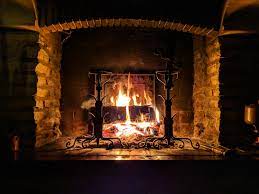
In my experiences Hearth Places are where we can Reclaim Conversation, Be Still, and linger in dialogue with others. Parks offers, “Because dialogue does not mean two people talking, but rather “talking through,” time and places for talking through are essential in forming critically aware, inner-dependent, and worthily committed faith.” The time that is required to dialogue about Big Questions compels us to linger in time and space, as we often do when we experience the hospitality of being Welcomed to the Table or in a Hearth Place. I was reminded this past week, while viewing a series set in a past decade, of the fact that on college campuses of old, a professor’s office often allowed space for a fireplace and a table, a place where faculty and students could linger and dialogue without interruption while delving into the search for answers to some of life’s Big Questions. Because these spaces are no longer available structurally in our departments, perhaps I need to become intentional about creating Hearth Places in other ways.
“Students do not want simply more office hours. Coworkers and colleagues do not want an appointment. There is a hunger, however, for hearth and for conversation that begins as it happens and concludes whenever. The practice of the hearth place can be recovered in a variety of forms and throughout a wide range of organizations and institutions. We know the difference between offices and homes that are at least sometimes willing to run on hearth time and those that cannot or will not. Mentoring environments find a way to practice hearth time,” shares Parks. Whether the Hearth Place is an actual fireplace, a dinner table, a sofa in your living room, or a walk through nature, “Emerging adults are drawn to those places that nourish them: places that in very practical terms recognize that the body, the heart, and the intellect are intimately interrelated and the whole is nourished. The practice of the table [and Hearth] can play a significant role in creating meaningful and mentoring networks of belonging that serve the formation of adulthood in often subtle but significant ways.”
Once again, I remind us of the vital role that mentoring provides, regardless of which Season of Life we are currently in; no matter our age, we have something to offer to those within our influence, a Hearth Place where we can grapple with the Big Questions that arise as we journey on this pilgrimage to a Flourishing Life. We can offer an ear that embraces a Listening Life so that we may share our Worthy Dreams without fear of being teased—our Hearth Places can come in a variety of locations and methods—we just need to be willing to share them!
As you consider Hearth Places from your own life, do any conjure up pictures in vivid detail? Please consider sharing in the comments below so that we may all consider new ways to offer hospitality and mentoring to others.
References:
Lake, C.B. (2020). The flourishing teacher: Vocational renewal for a sacred profession. IVP Press.
 Flourishing @ Life
This is probably my most favorite writing you’ve done. I’m truly working on Hygge/ simplicity in my life. Thank you for your writings and inspirations. Blessings to you today.
Cathy Headley, Ph.D. Associate Professor Rockford University Department of Kinesiology 5050 E. State Street Rockford, Il 61008
>
LikeLike
When possible, I try to meet with students in the commons area of our building. The chairs are better, there is more space, and it feels more relaxed. I can bring my IPad to use to check schedules and degree audits. Not every meeting can be there – sometimes we need more privacy, but it still serves as a great place to watch students open up.
LikeLike