
While preparing a presentation for a special college course geared towards equipping college students to flourish in the transition from the college campus to the professional world, I found myself researching topics related to the concept of a Red Flag. Although I was ill-equipped to handle the plethora of relationship advice offered online, I was able to navigate through the clutter to discover some worthwhile content for the module on decision making. And in addition, I now feel fully informed because I also learned there is a Red Flag emoji I can utilize in my communications with Gen Z!
Although Red Flags are used in a variety of situations, my mind tends to lean towards the idea that critical weather conditions are expected to occur, such as with a hurricane warning; therefore, I picture the U.S. maritime warning flag which contains both a red and black square when someone utters the phrase Red Flag. But the reason I began my investigation into this topic was in an effort to guide students, not only through issues related to Decision Fatigue, but to be aware of the times when something feels “off” about a certain situation–to not ignore what some people might call a gut reaction. What I wish I had done when something nudged me not to leave my purse in the car at the MidSouth Coliseum. I ignored that nudge and the purse was stolen from the vehicle while I was attending a Tigers basketball game.
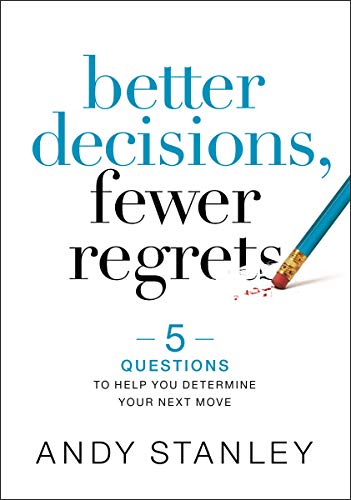
More important than the issue of having to replace keys and cards is the idea which Andy Stanley refers to as a Red Flag moment in his book entitled Better Decisions, Fewer Regrets. He shares that a Red Flag moment can happen when “…an option we’re considering creates a little tension inside of us. Something about it is just a bit uncomfortable. Something about it doesn’t seem exactly right. It gives us pause. It bothers us. It causes us to hesitate. And oftentimes, we have no idea why. Experts sometimes refer to this phenomenon as a red flag moment… When that happens, you owe it to yourself to pause and pay attention to the tension. Don’t ignore it. Don’t brush it off.”
The story Stanley uses to illustrate a Red Flag moment comes from Scripture in 1 Samuel where we learn of Saul’s mission to kill David. After being on the run for his life, David has an opportunity to end his life on the run, yet he chooses to spare Saul’s life instead. “Imagine the emotion in the cave that afternoon. The adrenaline. Imagine the pressure David felt to act, to save his men from another season of hiding out like bandits and risking their lives day after day. But David felt something else as well. A tension. A hesitation. Something wasn’t exactly right about all of this. But that inner hesitation made no sense in light of the circumstances in which he and his loyal men found themselves.” David was experiencing a Red Flag moment and does something very few people have the self-control to do, he made a pivot and “changed course mid-stream.” He was paying attention to the tension.
The emotional tension David experienced teaches us a valuable lesson, as Paul Naeger shares, “Our emotional system can give us an advantage in decision making if we make proper use of it. Emotions can tell us something about the world that we may not have accurately perceived in another way. Our lives are filled with emotional decision making on a daily basis. By simply paying attention to ‘red flags’ and evaluate what they mean, we can help determine if it is appropriate to make an emotional based decision.” Whether the Holy Spirit is asking us to Notice a Nudge or another internal alarm is blaring, we might be wise to heed the hesitation, even when we can’t clearly explain why.
Red Flags may appear in a variety of situations, from a career opportunity to a relationship decision to a life-saving moment, and I encourage us all to use wisdom and prayer to help us navigate whatever circumstances we find ourselves in. None of us will escape life without some decisions we regret, but the fewer of them we make, the better our life will be. Have you been in a situation where a Red Flag prompted you to pay attention and that led you to make a wise decision? Please feel free to share your story in the comments below.
References
Kampakis, K. (2020). Girls: Don’t ignore red flags when dating. [Blog post]. Kari Kampakis. Retrieved from https://www.karikampakis.com/2022/02/girls-dont-ignore-red-flags-when-dating/
Naeger, P. (2015, August 4). Psych 256: Cognitive Psychology SU 15. “Red Flag” Decision Making. Retrieved from https://sites.psu.edu/pscyh256su15/2015/08/04/red-flag-decision-making/
Stanley A. (2020). Better decisions, fewer regrets: 5 questions to help you determine your next move. Zondervan.
 Flourishing @ Life
I tend to hear the phrase “red flag” a lot. I think that has to do with my generation and just the. world we live in now. I have gone to a Christian school and have been in church my whole life. I have gotten a lot of advice on relationships and things like this. I understand a “red flag” is not only pertaining to relationships, but it is what people usually point it toward. While we are called to love others as Jesus loves, we are also told not to be in a relationship with someone unequally yoked. A “red flag” feeling is usually right. That shouldn’t change how we treat people, but maybe should change how we act on those bad feelings.
LikeLike
I often have “red flag” feelings toward people and struggle to differentiate between whether it is an actual red flag or if I am just being judgmental. It is good to pay attention to our feelings, I think, but it is also important that we pay attention to logic as well. It is definitely hard to pay attention to red flags without feeling like we are lacking trust in people. However, I agree with the statement that paying attention to red flags can help us to make better life decisions. Acting strictly on impulse can be unwise, so we should turn to God for proper discernment of situations and seek His guidance to navigate our emotions.
LikeLike
Pingback: Held Hostage – Flourishing @ Life
Pingback: The Great Rewiring – Flourishing @ Life