
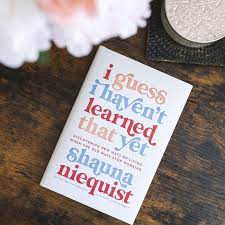
“I haven’t learned that yet” is a phrase that I’m choosing to embrace as an idea of Still Learning because I believe it has practical applications to all five Habits of a Flourishing Life. Shauna Niequist wrote down this sentence after an experience with her sons as they were navigating a move from the Midwest to Manhattan and encountering differences in their school environments. “The boys were doing great, but they had a lot of questions, and what I realized was that there were deeper questions under their questions—they were asking about piano and recess and buses and lockers, but what they were really asking was, Have I failed? Have I fallen behind? Am I dumb?” In efforts to guide themselves through this period of transition and the unknown of a new city, the Niequist family embraced the phrase that became the title to the book, I Guess I Haven’t Learned That Yet. For her family, this phrase offered “a common language for what it means to be a learner, a beginner, to be curious and make mistakes and get back up. To ask questions and figure it out as [they] go.”
Welcoming this concept of Still Learning is crucial for me, and for anyone else transitioning into a new season, whether it’s into a new role or a new location. Although my change is not a dramatic one like the Niequists, I still find myself thinking fairly often, “I haven’t learned that yet” when a student-athlete asks a question in which I fail to have an answer. “Please be patient with me, I’m Still Learning this role.” Andy Stanley reminds us in his message entitled Listen that no one is ever old enough or wise enough to not need outside counsel, even the wisest man who ever lived, King Solomon, wrote about seeking advice and continually learning from others. “Invite smarter people into the room,” advises Stanley, “The wise person is always in learning mode and they resist the temptation to think they don’t have anything to learn.”
So, what applications about Still Learning can be made to the Five Habits? Let’s take a look. The Habit of Awareness is about knowing yourself and others; therefore, knowing what you don’t know is vital to understanding what you need to know. If the Habit of Deep Work is connected to production and intensity, we must grasp that certain environments are constructive to learning while others distract us and impede our education. If sowing and reaping are the themes that describe a Habit of Growth, a flourishing person will embrace a growth mindset not only for what they are Still Learning, but what they may share with others. If loads and limits are the foundation for a Habit of Margin, we will continually need to understand the need for boundaries to protect the people and things that we value the most. Lastly, the Habit of Resilience is grasping the need to persevere when life doesn’t follow the path we may have planned and choosing to refocus on our passions when our attention to our God-Given Space goes awry.
Returning back to Stanley’s idea of Still Learning from wise counsel, I encourage people in all Seasons of Life to carefully reflect on the people they are choosing to invest Relational Equity in. Do they offer honest and constructive feedback from a desire to see you flourish? Often the tension that arises when that conversation occurs is because we know deep inside that we are Still Learning how to do this thing called life, and the advice that is being offered is desperately needed, even if we don’t want to hear it.
If you ever desire to gain a perspective on how much you don’t know, just visit a library. Take one long look at the books you haven’t read. Or take the virtual road and do a database search on a topic that interests you. How many hundreds of thousands of results appear for you to browse? Even Solomon chose to embrace a life of continual learning. Let’s assume we were only granted a portion of his wisdom and embrace early in life that no matter what our Chronos clock tells us about our age, we still have the need and capacity to Still Learn.
Let’s share some wisdom now…What strategies have you discovered that offer you the opportunity to Still Learn? Please consider sharing in the comments.
References:
Stanley, A. (2022, August 21). You’ll Be Glad You Did. Part 2: Listen. [Audio podcast]. North Point Community Church. Retrieved from https://northpoint.org/messages/youll-be-glad-you-did-2022/listen
 Flourishing @ Life
The best advice I ever received was given in four words: “Be – and STAY – curious.” By following that advice, I can’t HELP but be in learning mode all the time.
LikeLike
Pingback: Amazing Ambiguity – Flourishing @ Life
Dr. Powell, this is a great post and topic. I feel like in this day and age people are expected to have everything figured out all of the time when that is not remotely the case at all. This post reminds me of a quote I have seen recently talking about motherhood and respecting your parents. The quote goes along the lines of being patient with your parents because this is their first time through life as well. I think that quote and this blog post go hand in hand because we are all going through life for the first time and it will never get any easier or less amazing. I think society as a whole needs to give more grace to each other as we are all still learning every day. I struggle with this concept myself because I don’t like to try new things or participate in things I haven’t learned yet because I am not instantly good and whatever the activity or event is. I think this theme is a good way to encourage yourself to get outside of your comfort zone and continue to learn throughout all phases of life.
LikeLike
I really connected with this write up, I feel like now a days people take so much of what they see and are told for granted and are not learning whilst they’re living. So many people no matter the age feel like they’re suppose to have all the answers and know how to do everything and when they can’t it affects the way they live their lives as they feel less worthy than others. Speaking openly about the willingness to always learn and try to be better is key in growing as a person. The phrase “I guess I haven’t learned that yet” shouldn’t put you down but it should motivate you to want to be better.
LikeLike
The idea of still learning has been on my mind often since I came to the U.S. to study. Not only did I have to learn how the school system here works, but I also had to figure out how to navigate life in an unknown place. During this time, I thought to myself multiple times that I was behind, that I wasn’t as smart as my other classmates, because I didn’t understand references that the professors made during class. However, all of this sparked a change in me; I became less scared of asking questions and saying out loud that I did not know something. I realized that people would help me if I asked about it instead of judging me, and this made me become more encouraged to talk to new people and try things that I do not fully understand yet. Now that I am approaching graduation and thinking about grad school, these feelings of insecurity are resurging in me a little; the new processes and new life ahead of me do scare me, but that is ok. Upon reading your blog post, I caught myself thinking about these things and reflect how much I changed in the past years, how I have adopted the idea of “Still learning” without fully understanding what it was. Life has its ways, and I believe that God only gives us dreams that we can achieve, so I am excited to dive into the unknown one more time and learn what I don’t know yet.
LikeLike