
Have you ever had anyone use the inquiry, “Won’t You Reconsider?”, conceivably in an attempt to express concern that you were about to make a poor decision? It’s a really polite version of Have you lost your mind? or You really think that’s a good idea? Really!?! Perhaps it would be an effective question a parent might post to one of their very own flesh-and-blood or a teacher to one of their students when they deeply desire that a member of this younger generation rethink their choices. Conducting an online search about the concept of reconsidering, you might find a similar phrase such as “change one’s tune: to rethink; to reach a different conclusion; or to proceed with caution.” All of these are effective guardrails to use in decision making and these ideas were brought to mind while reading Knox McCoy’s All Things Reconsidered.
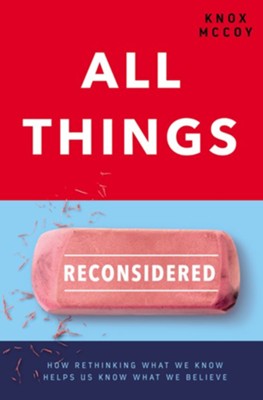
Using the imagery of a pink, beveled rubber eraser on the cover, McCoy challenges us with the idea that all of us might benefit from taking the time to rethink, to deeply comprehend what we know and what we believe. He’s asking, “Won’t You Reconsider?” This reflective process may result in either us choosing to edit our ideas as one erases a thought written in pencil, or solidifying the idea as we do when writing in ink. Now, some of the concepts where McCoy asks, “Won’t You Reconsider?” have all of the life significance of occurrences like Carla, my stylist, asking, “Are you sure you want me to cut bangs?” or “Who is the greatest professional basketball player of all time—MJ or Lebron”? However, the most profound questions he proposes relate to avoiding issues like Confirmation Bias and cultivating of a Habit of Awareness, where we learn about our God-given design and how those fit into the world around us. McCoy suggests we rethink or Reconsider the relationships, practices, and habits in our lives that can become a Default Setting rather than an intentional choice.
Like McCoy, this current journey to grasp what are the Habits of a Flourishing Life has been a continuous experience of discovering, exploring, and reconsidering ideas from Scripture, my religious affiliation, my education, and my life experiences that have accumulated to create the person I am today. In addition, this investigation is leading to scholars, researchers, and theologians who genuinely care about what it means for humans to flourish—in their personal life, in their communities, and in society as a whole. Are there steps that mentors, leaders, and guides can encourage Emerging Generations to embrace that will improve their odds of flourishing and reduce moments floundering or failing?
If my desire is to flourish at life regardless of the circumstances around me, perhaps McCoy’s challenge to rethink will have me changing my tune or allow me to keep singing the same precious song. “We are born with an inheritance of geography and contexts that typically preconceives and provides what our interpretation of the world will be. This is not necessarily good or bad; it just is. Whether it is about sports, matters of faith, or cilantro as a crucial component in good queso dip, we are conditioned to believe a certain defining philosophy.” However, Won’t You Reconsider…
- What role digital devices have in our lives? Would we benefit from constructing a Digital Philosophy that provides boundaries for how much power those devices are given in our approach to daily life?
- What church means to us in this particular Season of life? McCoy asked himself questions such as, “Where would I go? What denomination would it be and how frequently would I go?”
- Who we allow to speak into our lives? Which relationships are toxic to the person we aspire to be? Who exhibits the characteristics we want to emulate? How can we learn from them?
- How the daily choices we make either lead to or away from the healthy lifestyle we desire? Are we eating the right foods, engaging in physical activity, and sleeping adequately? If not, what needs to change to embrace healthy habits?
- Who is that person “on the other side of the aisle;” that neighbor with a different ethnicity, that leader who doesn’t think like us? What if we truly believed that they are an Image Bearer of God?
- What hill are we willing to die on? Will accepting that job/promotion interfere with time for our family? Are those unhealthy habits so ingrained in us that it’s too late to make better choices?
Reconsidering, the way that McCoy and many others are challenging us might require some recalculating, even some recalibrating in order to rethink how “our past experiences, our current circumstances, and our future hopes and dreams,” as Andy Stanley would say, will impact our flourishing. McCoy offers, “having to recalibrate and reconsider isn’t indicative of a problem; it’s indicative of growing our understanding of the divine as we grow to understand ourselves and the world around us.”
Many people gave faced moments of Reconsideration in their lives—it’s just a part of being human. Were you ever provided wise advice as you pondered a move, an opportunity, or a choice? Please consider sharing in the comments below to extend this conversation.
References:
Stands4, LLC. (2001-2022). Phrases for the word reconsider. Retrieved from https://www.phrases.com/psearch/reconsider


This was an interesting article. Until now, I have not thought much about “reconsidering” or “rethinking” about how my past experiences and my future dreams may affect my own flourishing. I do want to live a purposeful life but I do not want to sacrifice my home life and the joy of living just to get promoted or work longer hours if it is not the best fit for myself or my family.
Thanks for posting this article.
LikeLike
Reconsidering can sometimes make you feel like you’re making the wrong decision and at the beginning of the school year, I felt like I made the wrong decision by coming back to school. However, I have come to realization that, that was one of the best decisions I have made. I can always get another job, but this opportunity might not have been presented to me again.
LikeLike