
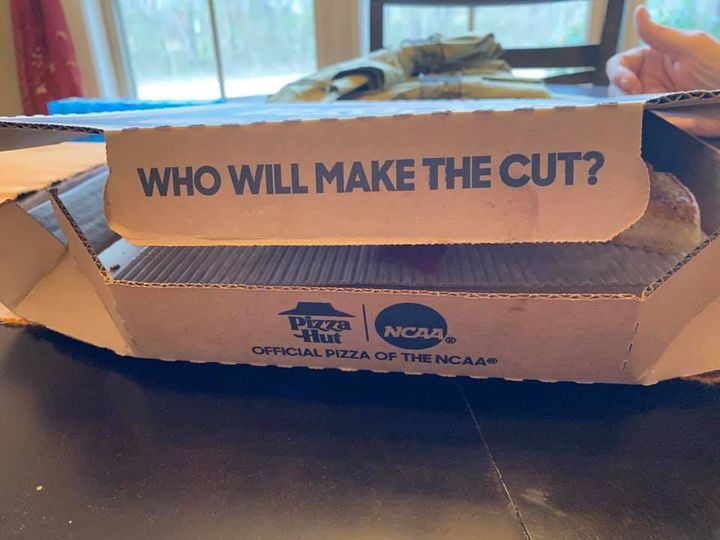
It’s March 13, 2020, and as we sit at the dinner table preparing to enjoy a deep-dish pepperoni pizza, the creative slogan, from the official pizza of the NCAA, printed across the side of the cardboard box asks, “Who will make the cut?” My response to this inquiry on that particular day was, “No one, Pizza Hut. Absolutely no one!” Although the world had been anxiously following this strange virus known as COVID since January, a new reality hit when March Madness was canceled. For many, the dire consequences of this pandemic had already devasted families, but for others, it took a broader impact on society, something related to sports, to be the wake-up call that something significant and unprecedented was happening. And I was shocked!
Although life was disrupted for me, it was not devastated due to the pandemic, and I actually relished the opportunity to reevaluate what was meaningful and purposeful in my life. Since the age of fifteen, sports had been an integral part of my personal and professional life, but now I was being provided an opening to take an objective perspective on the role it played in my day-to-day life. Admittedly, it was nice to take a break from the constant, even hourly, changes that occur in the world of sports. Rather than living my life by an athletic schedule and a day full of hourly time slots, the rhythm of my days embraced a new normal. And I relished it!
You see, my context of time was altered due to circumstances outside my control, and it was beneficial to my health and wellness. Classes were still meeting, assignments were being graded, scholarship was being completed, but the rhythm was altered—the process was slowing, which offered a beautiful occasion to spend time lingering, with not only work, but in Scripture and in conversations with others. My context with time had been altered. There was not somewhere I was expected to be and there wasn’t a game/event I was missing because I chose to linger where I was. And it was beautiful!
Nearly three years removed from the day basketball stopped, I sit here being challenged with content from Kelly Kapic’s You’re Only Human, ironically while watching college football on television. At the conclusion of his chapter entitled “Do I Have Enough Time?”, I locate my notebook entitled “Take It Slow,” and begin scanning all the resources related to our relationship with time that has come into my awareness in the last few years. Researching a topic such as flourishing at life, my initial assumptions were connected to time in a peripheral way, but the pandemic, and life since, has brought this issue of our relationship to time to the forefront of what it means to flourish. And I’m troubled!
You see, rather than standing firm and remaining courageous against returning to a life dictated by an hourly clock and busyness, I’m following the current right alongside everyone else. Instead of a weekend spent in rest and reflection, I’m scouring the internet trying to navigate when and where all the events are for the celebrations occurring on campus. All exciting expressions of how the Lord has chosen to bless our campus for 200 years, and yet, I find myself attempting to do too much. Even though they are all wonderful and meaningful, I can’t engage in them all! And I’m frustrated!
And all of this reflection brings me back to concepts I’ve shared before under the theme, Take It Slow, but it’s Kapic’s perspective that is pleading to me, and the entire Western world, to engage in Recontextualing Time. “We reap the benefits from the standardizing of time, and it is certainly not my goal to sound like a Luddite who romanticizes the past and demonizes the present. But since we do inhabit this present age, it can be hard for us to see how driven we are by the clock. And not all the effects are positive…When efficiency and productivity are always treated as having dominant moral value, then those who are ‘slow’ will be left behind.” And I feel behind!
So, what Kapic is challenging readers to do is to embrace Recontextualizing Time. “Western culture tends to define personal identity by isolating the person from all context. The Christian faith always understands the person as finite and necessarily in connection: with God, with other persons, with the creation at large, and within the person.” When this happens, when we don’t expect humans to be machines, but understand that humanity brings finitude which also brings loads and limits, we can deeply inhale, escaping this pressure of busyness that the world values so much. And I’m released!
Recontextualizing Time will require more than one simple blog post to examine its depths, but I wonder how your relationship to time has evolved since the beginning days of the pandemic. Have you returned to “normal” or has it brought about change in your life? Please consider sharing in the comments below.
Reference:
Kapic, K.M. (2022). You’re only human: How your limits reflect God’s design and why that’s good news. Brazos Press. (UU BT 702.K37 2022) (September 2022)
 Flourishing @ Life
Since the pandemic, my life has somewhat started to go back to normal. When my family travels, we are very aware of our surroundings and make sure that we are thinking about our health. Before the pandemic, we would have not done this. I was in high school when the pandemic hit, there my life completely stopped and I was heartbroken by it. I was missing my senior year and knew that I could never get it back. Being a high school student, I was not concerned about the pandemic and did everything my parents would allow. Looking back time started to slow down, and I was able to reflect on my life and what my dreams and goals were once the pandemic was over. I had a lot of time of what I wanted to do and what I wanted to accomplish in the future.
LikeLike
Pingback: Reset Button – Flourishing @ Life