
A decade…ten years…if you have lived less than two decades, you may have little to add to this dialogue; nevertheless, I propose that even those remaining in their teens might offer some perspective on what changes they have observed over the last decade. For me, the differences between decades emerges from interactions with students, or a funny meme about a phrase like 10 years ago is truly meaning 2013 and not the 1990s, or in the awakening reality of a simple task like shredding old financial documents. During this annual process of replacing the outdated tax information with more recent, it dawned on me how many of the receipts were from retail places no longer in existence (or at least on life-support)—Gander Mountain, Hallmark, JC Penney, Sears, and Kmart.
This evidence of change in retail habits is just one of the numerous examples you could cite to support how life has evolved recently, but it’s doubtful that anyone would disagree with the transformation we have all witnessed to becoming a Screen Culture in nearly all aspects of daily living. With the introduction of the iPhone and Kindle in 2007, along with the cascade of all other digital devices that followed, life as we once knew it, no longer exists. And as an avid reader, an educator, and an innately curious person, I’m deeply interested in how this transition is impacting our “learning, knowing, and remembering,” especially as it relates to cultivating a flourishing life.
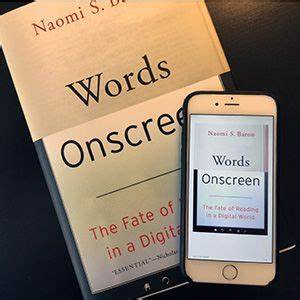
With encouragement from my colleague, Jeannette Russ, to read Non-Computable You for a discussion panel and picking up Words Onscreen from the “new books” section in the Union library, my Christmas reading led to pondering what transforming to a Screen Culture will mean for all of us in the days ahead. Specifically, I was curious to investigate what researchers have uncovered with regards to the options of reading onscreen versus print. What does this mean for the college students currently in my classes who demonstrate little interest in reading books? What impact will this have on participation in discussions and class assignments, especially in light of the high price of printed textbooks and students opting out of purchasing? And lastly, what effect, if any, is this digital media having on our ability to communicate?
Anyone who attempts a discussion on the preference over print to digital reading will usually find strong opinions on both sides, and as someone who actually enjoys both mediums because of the personal benefits, I am truly interested in the experiences of others. What is revealed in Baron’s work is consistent with my previous opinion that we all should develop a Digital Philosophy to protect ourselves from the harmful effects of a Screen Culture, especially in light of what is uncovered with regards to our shrinking attention spans. Baron shares, “A study commissioned by Time Inc., called ‘A Biometric Day in the Life,’ found that subjects in their twenties switched media sources 27 times an hour—barely two minutes per landing. While advertisers may take such data as a clarion call to ramp up the graphics if they want to hold eyeballs, those of us losing sleep over the diminishing attention spans of digital natives become increasingly uneasy… There’s a name for this type of mental flitting: hyper attention. And those who engage in hyper attention are primed and ready to be hyper readers.” Trust me, even if educators aren’t paying attention, your insurance companies certainly are with an uptick of overflowing bathtubs and stove fires!
My heightened concern with a Screen Culture goes beyond just reading for a class assignment or for leisure, “a generation characterized by hyper attention can be expected to carry over these habits of mind when it comes to reading. What happens to our minds if deep attention [a Habit of Deep Work] and deep reading become the preserve of only a handful of people?” Researchers continue to point out that Deep Work, including deep reading, cultivates essential skills such as “inferential and deductive reasoning, analogical skills, critical analysis, reflection and insight.” What happens when an entire Emerging Generation lacks these abilities?
Again, I am a fan of both print and digital methods of reading, however, there is an ongoing interest in how transforming from print to digital is impacting our world. Would you consider sharing a personal experience with our Screen Culture in the comments below? Perhaps we can all learn something new in how to navigate an unknown future.
References:
Baron, N. S. (2021). Know what? how digital technologies undermine learning and remembering. Journal of Pragmatics, 175, 27–37. https://doi.org/10.1016/j.pragma.2021.01.011
Baron, N.S. (2015). Words onscreen: The fate of reading in a digital world. Oxford University Press.
Marks, R. (2022). Non-computable you: What you do that artificial intelligence never will. [Kindle version]. Discovery Institute.
 Flourishing @ Life
This topic is very interesting to me, especially since I have opinions on both sides. Most of the time, I will prefer to read on my iPad due to the convenience only. When this translates into learning, I feel like I don’t learn as well when reading or writing on my iPad. I do it because it’s much more convenient and I can add photos into my notes to print later, but I genuinely feel that I learn more with physical paper and textbooks. The one advantage that the iPad book store has is that sometimes the page sizes are different. If there’s less words on a page and not tiny writing, I am more inclined to read more pages faster. This all boils down, of course, to the attention span. My attention span issue comes from the idea of being incredibly busy rather than focusing, so my brain is always on efficiently completing many tasks. I did not grow up always having a screen, I grew up getting dirty in the mud and hurting myself outside on the bike. But the world is changing, one way is in the recycling sense. I would highly encourage children to use physical books as I believe, this will help improve focus and limit distractions of notifications and temptation of doing something else on the screen. The main issue that arises is wanting to save paper. There are many ups and downs about this idea.
LikeLike
Pingback: Paper or Plastic – Flourishing @ Life
This is also something I have noticed over the course of the years. Not only do I find myself reading digitally more often, I also feel my attention spans has decreased as I am more online. It is harder for me to go into “Deep Work” and maintain that state for a longer period of time. When I do read online, I find myself adding an audio book so I can listen to the words I’m reading. As for reading in print, I only see myself participating in works such as textbooks and the occasional book on the beach. When reading through textbooks, I cannot get into the deep work state that I strive for, but I am more often looking for key words and topics that I need to know. Screen Culture is something I feel in my day-to-day studies and is not something I see going away anytime soon.
LikeLike
With the rise of digital devices, the way we consume information has shifted towards a more screen-based culture, which has led to a decline in deep reading and attention span. I found the thought-provoking questions about how this transformation is impacting college students and their ability to participate in discussions and complete class assignments very interesting. In addition, I also liked how you expressed your concern about the potential long-term effects of this digital media on our communication abilities and cognitive skills. This article is a reminder that while technological advancements have undoubtedly brought numerous benefits to our lives, there are also drawbacks that must be acknowledged and addressed. It is important to recognize that the way we consume information has changed significantly over the past decade and that this shift is having a profound impact on our minds and our ability to learn and remember.
LikeLike
I will definitely say i am apart of screen culture because everything i do is on my phone or an a electronic device. Although, i did grow up in a period before and during the screen culture so If it was not for me growing up literally as electronics were coming out i would probably not have any paper in my home. And the paper i do have is from when i was in school before electronics. But, as i grew up i seen less and less need for anything paper because what do you actually need paper for? Literally everything you can do with paper you can do electronically and its faster. I am not saying i am proud of the screen culture because i feel it gives us a sense of laziness because everything is in one place and we never have to leave. I am very thankful to have grown up before in during the screen culture because i got to see both sides, for example, i was not an ipad kid growing up i didn’t carry an ipad everywhere i went i just had to use my imagination. Kids now and days just bring an ipad and sit in one spot and never move because there stuck in the screen.
LikeLike