
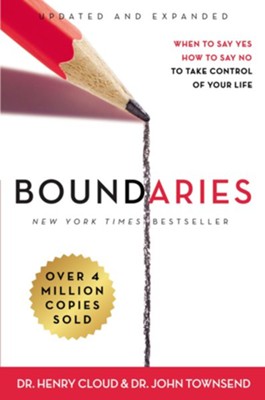
When I pull out my lawnmower and cut the grass for the first time of the season, it can sometimes be a challenge to clearly define where to stop on either side of my property, for there are no fences to prevent me from entering my neighbors’ grass. Once that first cut is made, it’s a fairly simple process to Follow Where I’ve Been because a boundary has been established between the invisible markers of our property lines. Just as I need established boundaries on my lawn, Henry Cloud and John Townsend share the importance of having markers in our life in their best-selling book Boundaries. “In the physical world, boundaries are easy to see. Fences, signs, walls, moats with alligators, manicured lawns, or hedges are all physical boundaries…In the spiritual world, boundaries are just as real, but often harder to see…these boundaries define your soul, and they help you guard it and maintain it (Prov. 4:23).” In this post, I offer that not only do we sometimes need physical and spiritual boundaries, but Digital Boundaries as well.
Since the first edition of Boundaries in 1992, the world has benefited from and been distracted by digital devices, therefore, the need for Cloud and Townsend to add a new chapter on Digital Boundaries in their most recent edition. The timeless information on boundaries is just as relevant today as ever and applies seamlessly to offering instruction on cultivating a Digital Philosophy that we can use in our own lives or in guiding emerging generations. With calls being billed at .45/minute in the early 90s, we could never have imagined the day would come that we would cut our landlines and hold minicomputers in our hands, but since we have now arrived at this juncture, we need to carefully consider a device’s place in our lives.
Choosing a passage of Scripture from Galatians, Cloud and Townsend demonstrate the practical wisdom found in the Bible for modern-day issues. Paul writes, “Do not use your freedom to indulge the flesh; rather, serve one another humbly in love” (Gal. 5:13). “This is the principle. You are free, and your boundaries are meant to protect that freedom. But do not use your freedom to hurt yourself or anyone else. Use your freedom to love…One way to do this—to make sure you are using technology rather than allowing it to use you—is to follow a principle Jesus demonstrated in observing the Sabbath…The Sabbath put a boundary on how much time God’s people spent on work so they could devote one day a week to rest and worship.”
In addition to engaging in a Sabbath from our devices, Cloud and Thompson share additional strategies for setting Digital Boundaries which include the following:
- “Phones are routinely turned off and put away during important relationship times (for example, family dinners, date nights, social gatherings, and conversations with friends).
- Email and social media are turned off during important work periods or other times that require sustained focus, productivity, and task completion.
- Social media engagement is limited to certain time blocks (for example, fifteen minutes twice a day).
- No technology is used thirty minutes before going to bed at night and thirty minutes after getting up in the morning.”
Now, in 2023, a fifteen-minute period sounds a bit restricting because of the numerous social media platforms that we engage on today; however, the idea is that some Digital Boundary is set that is appropriate for specific individuals. I know many find the idea that my cell phone remains in another room at night to be absurdly drastic, but it’s a healthy boundary for me.
Cloud and Thompson offer more than just practical steps for establishing Digital Boundaries, they offer a psychological perspective of how the distractions caused by these devices interfere with the Habit of Deep Work. But more than even the practical and psychological, these men recognize the importance of well-being in all aspects of life, and especially in our relationships with others. “So the point here is to be in control in a way that serves you, your relationships, your life, your mission, or whatever your objectives may be. There are no absolute rules about technology, but we can set up helpful rules for ourselves.”
What strategies provide you with Digital Boundaries that allow your life and relationships to flourish? Please consider sharing some of these in the comments below. You never know when your idea is the one that someone else desperately needs to read!
Reference:
Cloud, H. & Townsend, J. (1992). Boundaries: When to say yes, when to say no, to take control of your life. Zondervan.


Dr. Powell,
I very much enjoyed this blog post about setting boundaries. Something that comes with having a love language of quality time is being present in moments of fellowship and conversation with others. I believe that phones and technology is general can be a hinderance to our relationships if we let them. Your suggestions about putting phones away during important relationship times. These are things that I follow as well and I think that these influence my relationship positively.
For myself, I find that my phone can be a large source of distraction for me when I am needing to get work done and complete tasks. Something that helps me combat this is to utilize the “do not disturb” feature, where my phone will not notify me of text message, emails, or any other notifications until the feature is turned off.
LikeLike
I really enjoyed reading this blog post because setting digital boundaries has been something that I have been trying to work on for a few weeks now. Growing up in this generation can be hard sometimes due to the fact that we have been able to post about our lives every minute of every day. This can be a positive thing, but it can also be extremely negative.
I have recently read a book called “Digital Minimalism” by Cal Newport that has tons of great ideas and encouragements as to why we should pull away from the screens. I highly recommend!
LikeLike
LikeLike