
Take a moment and reflect: when you think back to your childhood, can you picture the dishes or flatware your family used every day?
Until Hannah Brencher planted the seed of Big Forks, Little Forks in her book The Unplugged Hours, I’m not sure I could have described my parents’ silverware pattern, despite nearly fifty years of loading and unloading forks, knives, and spoons into the dishwasher. I could have told you how often the spiky ends got stuck in the little squares of the silverware basket. I could have described the frustration of trying to scoop butter from a tub with the pointed end of a knife. But could I have told you that the handle featured a rose pattern with three leaves above and three leaves below? Not a chance.
In hindsight, I should have known there was a 99.9 percent chance that silverware came from Sears. Nearly every material possession from my childhood seemed to originate from a Sears catalog, outlet, or retail store. Think Walmart, younger readers.
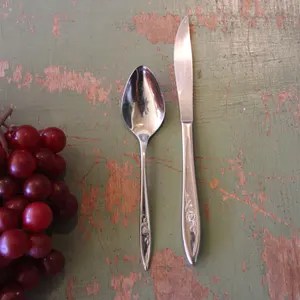
The fact that I recently asked my mother to send me a photo of that silverware so I could search for the pattern name illustrates more than one point Brencher makes in Unplugged Hours. First, we can lose ourselves for hours chasing answers on our digital devices. What begins as a simple search for a silverware pattern can quickly become a rabbit trail of clicks and distractions. Second, our lives are often shaped far more by what happens during Ordinary Time than by major milestone moments. And perhaps a third observation emerged as well: if my mother is willing to take a photograph of her spoons for one of my writing projects, she will probably do just about anything for anyone.
Now, if I’ve already lost some of you because your family referred to utensils as a salad fork or dinner fork, I apologize. In the Powell household, there were only two categories: Big Forks and Little Forks. Which circles me back to Brencher’s insight.
I don’t know when I graduated from using a Little Fork to a Big Fork. There was no commemorative photograph. No certificate. No scrapbook page documenting the occasion. No social media post proclaiming, “Big day! Officially using a Big Fork now.” Yet I know there was a season when the Little Fork was my preferred utensil. At some point, without fanfare or announcement, I simply grew into the Big Fork. Isn’t that how much of life works?
Most of us spend a tremendous amount of time worrying about the big decisions. We agonize over where to attend college, whom to marry, which career to pursue, whether to relocate, or if we should accept a new opportunity. Brencher calls these the Big Forks of life, the decisions that seem capable of changing our entire trajectory. Those decisions matter. Yet Brencher offers a surprising observation: our lives are often shaped even more profoundly by the Little Forks we encounter every day. These choices appear insignificant in the moment, but over time they accumulate and ultimately define who we become.
When I reflect on flourishing at life, I often think about my own tendency to focus on the Big Forks. Like many people, I once assumed flourishing would arrive after the next accomplishment, the next degree, the next promotion, or the next season of life. I imagined flourishing was waiting somewhere out on the horizon. The more I study well-being, faith, and human flourishing, however, the more convinced I become that it rarely emerges from dramatic moments alone. More often, it grows through small, repeated acts of faithfulness practiced over time. The Little Forks usually arrive disguised as ordinary moments.
One of the most compelling ideas in The Unplugged Hours is Brencher’s challenge to cultivate an Unhurried Life by intentionally powering down and embracing the Power of Presence. She describes unplugging not as deprivation but as a pathway toward greater awareness, deeper connection, and inner peace. Developing a Digital Philosophy.
That idea resonates deeply with my own exploration of the habits that cultivate a flourishing life. In a culture that celebrates busyness and rewards constant connectivity, many of our Little Forks involve choosing attention over distraction. Every time we set aside a device to engage with another person, enjoy creation, reflect in solitude, or spend time with God, we make a small investment in the life we are becoming. The beauty of these choices is that they compound.
The irony is that while we often remember the Big Forks, we are usually formed by the Little Forks. The daily decisions made in Ordinary Time quietly become the foundation of an extraordinary life. A flourishing life is not built through occasional acts of greatness. It is constructed daily through the consistent practice of the Five Habits of a Flourishing Life.
And perhaps that is the lesson hidden within a childhood drawer full of Big Forks and Little Forks. The moments that seem too small to matter may, in fact, be the very moments that matter most. And be honest if you are now heading to look into your silverware drawer!
Reference:
Brencher, H. (2024). The unplugged hours: Cultivating a life of presence in a digitally connected world. Zondervan.

