
Had I attended the birding workshop at Clay Hill Memorial Forest or consulted Dr. Andy Madison, I might have understood what unfolded before me. Instead, I was given a quiet, everyday moment that carried a profound message—no pulpit, no sermon—just persistence revealed in real time. This spring, the message arrived in the form of a robin—or, as a sweet toddler once corrected me, a “robin redbreast.”
It began under the eaves of my front porch. A small bundle of grass and mud slowly took shape in a place that, quite honestly, I didn’t want it. Practical concerns quickly took over: the mess, the location, the inevitability of droppings and disruption. So, I removed it. One firm sweep of the broom handle—problem solved. Or so I thought.
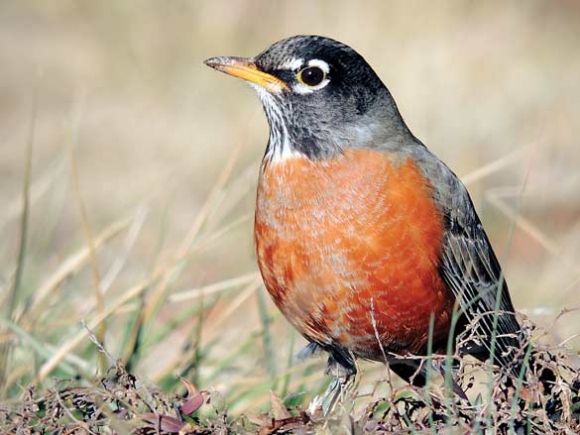
A week later, the robin returned. There it was again—the beginnings of something familiar. Twigs arranged with intention, grass woven with care. She had come back to rebuild. Once more, I took it down, more convinced this time that I was being decisive—responsible, even. Surely, she would get the message: Look around. Choose a tree. Not my porch.
But by the third time I dismantled her work, something in me began to shift. It wasn’t just annoyance anymore—it was attention. Why did she keep coming back? And then, as if to deepen the lesson, I noticed something else: she wasn’t alone. Nearby, a male robin—his brighter chest unmistakable—kept watch. He would arrive with worms in his beak, landing near the forming nest and gently offering his find. Sometimes she paused to receive it. Other times, she kept building while he stood guard—steady, present. This quiet rhythm of provision and partnership played out again and again. Even as the nest was torn down—once, twice, three times—they continued. Together.
What instinct compels a small bird to begin again so persistently? There were countless other places they could have chosen—plenty of trees, easier and less contested spaces. And yet, they returned—quietly, steadily, without protest. That’s when I realized I was witnessing a living picture of perseverance and provision. The robin did not argue, retaliate, or dramatize her loss. She didn’t abandon her calling. She simply began again. There is something sacred in that kind of persistence. In a world where we are quick to quit—when outcomes don’t come easily, when resistance rises, when our efforts feel undone—these small creatures embody a different rhythm. A rhythm grounded in purpose, not convenience. A commitment rooted deeper than setbacks.
They seemed to know what I often forget: difficulty does not necessarily mean something is wrong. Yet how often do we interpret obstacles as signs to stop rather than invitations to continue? How often do we treat closed doors as final verdicts instead of pauses that call for renewed effort, reframed vision, or deeper resolve? We all experience fallen nests—plans that unravel, dreams that stall, relationships that strain, efforts that seem wasted. And the question inevitably comes: Do I begin again?
Beginning again is an act of courage. It is a refusal to let disruption define direction. It is choosing faith over frustration, movement over resignation. It is accepting provision when it comes—like a quiet offering from a steady companion. Creation itself leans toward persistence.
Eventually, I stopped removing the nest. Instead, I started observing. And in that watching, I learned: flourishing is rarely tidy. It often appears in inconvenient places. It requires resilience that outlasts discomfort. It invites both persistence and partnership—building and providing, striving and sustaining. So I wonder: what in your life is waiting to be rebuilt? What have you laid down after the first fall—or the second, or the third? And who might already be offering support, even if you hadn’t noticed?
The invitation is not to move on, but to begin again—not stubbornly, but faithfully. Persistence is not about forcing outcomes. It is about aligning our purpose with our Creator’s, even when the path is interrupted. It is trusting that what we are called to build is worth the effort—and recognizing that we are rarely building alone. Flourishing is not found in avoiding disruption, but in refusing to let disruption have the final word.
So today, I’m BOLOing for the small messages in creation—the ones that remind us, without saying a word, that starting over is not failure. It may just be faith in motion.


spot-on! thanks for sharing wisdom with us today
LikeLike